


AI Forecast · eGov

This is what AI says. It is an automated reading of publicly reported news, tenders and policy documents, generated by an AI model and published without guarantee. It is not a prediction of certainty, not investment, legal or policy advice, and not the editorial view of Elets Technomedia. Outcomes may differ. Please check the cited sources.
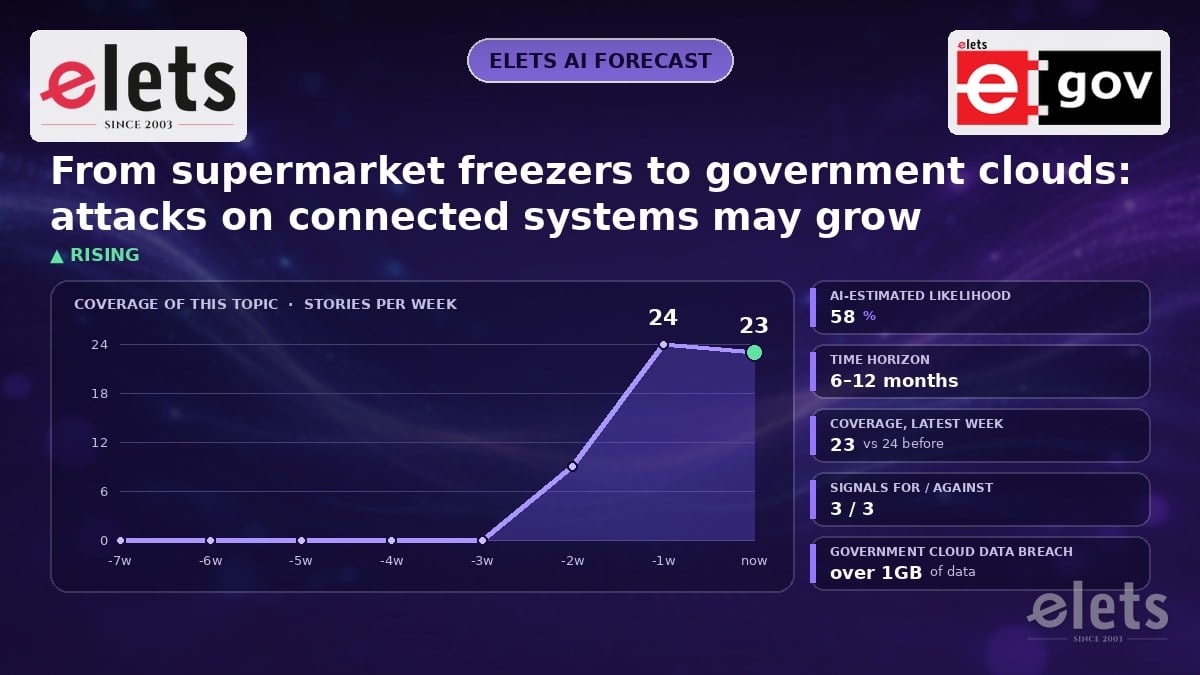
Sabotage of retail refrigeration in Europe, a government cloud breach and UK warnings about AI-powered attacks suggest operational and public systems could face rising pressure.

AI-estimated likelihood: 58% · Horizon: 6–12 months · Direction: rising

What the signals show
Hackers reportedly sabotaged supermarket freezers across Europe. Israel issued an urgent nationwide cyber alert in response, and a UK security chief warned that UK firms were 'exploited'.

The UK's cyber chief warned that the country could face AI-powered attacks on critical infrastructure within two years. A report described AI-powered malware targeting UK infrastructure as 'highly likely' by 2028.

Iran-linked DarkBlinders hackers reportedly breached government cloud systems and stole over 1GB of data. Separately, two new Ivanti Connect Secure zero-day CVEs carry a November 13 deadline.
Why it matters for India
CERT-In's enforcement powers over government patching are in focus. AI's reading is that public bodies may come under pressure to act faster on exploited flaws.
Reports that AI models can now find, exploit and patch bugs, and that an AI agent hacked GitHub in a government AI safety test, suggest attack tooling may be accelerating.
The global picture
The UK is advancing its Cyber Security and Resilience Bill, and the NCSC has outlined a National Detect Strategy alongside its annual review.
Cybersecurity M&A recorded 37 deals in October as AI security expanded, which indicates market expectations of growing demand.
What could change this
Defensive measures could blunt growth in successful attacks. These include passkeys replacing passwords, detection strategies and new resilience legislation.
The same AI capabilities that find bugs can also patch them, and patching mandates could reduce exposure.
Signals pointing towards it
- Real-world sabotage of connected retail refrigeration prompted national alerts.
- UK officials warn of AI-powered attacks on critical infrastructure within two years.
- Government cloud breaches and new zero-days show continued exposure.
Signals pointing against it
- Passkeys, national detection strategies and resilience legislation may strengthen defences.
- AI is also being used to patch vulnerabilities, and patching enforcement is tightening.
- The UK warning points to a two-year window to 2028, so a sharp rise may not appear within 12 months.
How the likelihood was estimated
Recent incidents and official warnings point upward. Strengthening defences and a warning horizon stretching to 2028 keep the estimate moderate.
What to watch next
- Further incidents involving operational or connected retail equipment
- Progress of the UK Cyber Security and Resilience Bill
- CERT-In patching directions after the Ivanti zero-day deadline
This is what AI says. It is an automated reading of publicly reported news, tenders and policy documents, generated by an AI model and published without guarantee. It is not a prediction of certainty, not investment, legal or policy advice, and not the editorial view of Elets Technomedia. Outcomes may differ. Please check the cited sources.