


AI Forecast · eGov

This is what AI says. It is an automated reading of publicly reported news, tenders and policy documents, generated by an AI model and published without guarantee. It is not a prediction of certainty, not investment, legal or policy advice, and not the editorial view of Elets Technomedia. Outcomes may differ. Please check the cited sources.
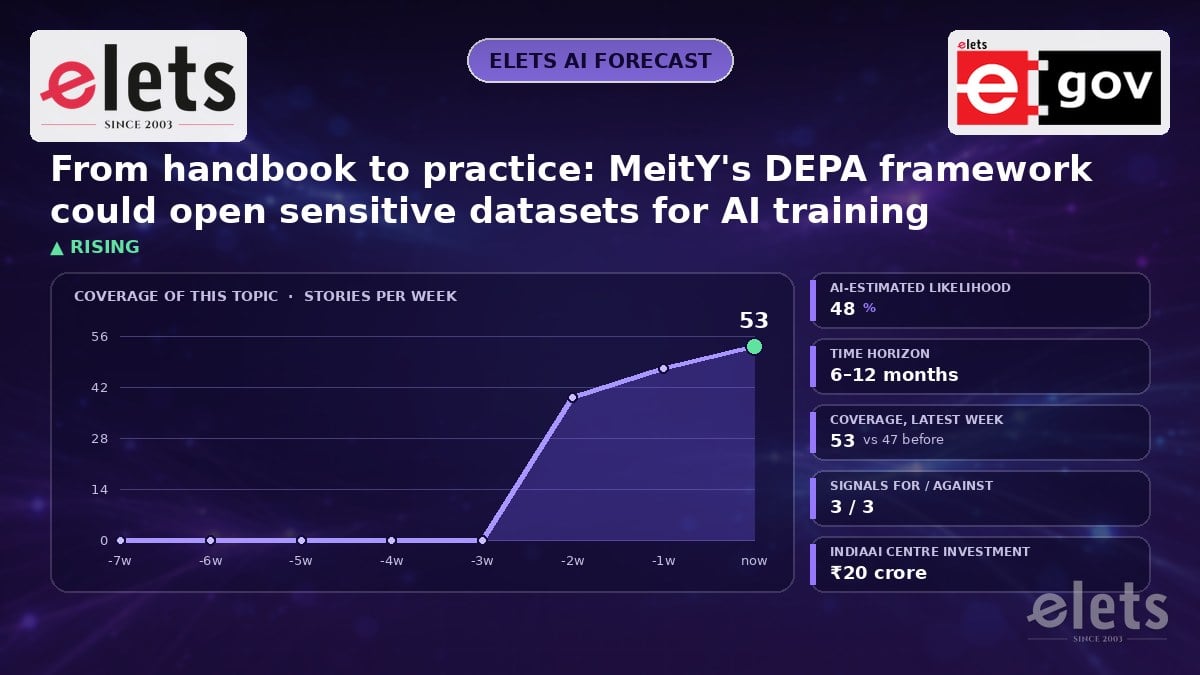
MeitY's new DEPA handbook proposes secure access to sensitive datasets for AI training, and global interest in digital public infrastructure suggests data-sharing pilots may follow.

AI-estimated likelihood: 48% · Horizon: 6–12 months · Direction: rising

What the signals show
MeitY has unveiled a DEPA framework handbook aimed at secure data sharing for AI training. Reports say it proposes secure access to sensitive datasets.

New AI capacity is being set up in India, such as a ₹20 crore IndiaAI centre at NIT Raipur focused on mining and health AI. AI's reading is that this kind of capacity could add to demand for structured data access.

Why it matters for India
Commentary argues that government AI success depends on modernising foundations first. A data-sharing framework could be one such foundation.
Consent obligations are becoming concrete in regulated sectors. Vendors are already offering tools to help banks and NBFCs meet DPDP and RBI consent rules before May 2027, which suggests consent infrastructure is developing in parallel.
The global picture
The Ethereum Foundation has launched a public-sector site positioning Ethereum for digital public infrastructure, with an emphasis on designing for sovereignty.
South Korea's Interior Ministry has sent a delegation to Estonia and France on public-sector AI. Separately, Qatar's digital services are described as offering AI opportunities. Both indicate wider interest in data-driven public services.
What could change this
Ground-level friction with data platforms, such as experiences of Adivasi farmers with AgriStack, could slow wider sharing of sensitive data.
Concerns about dependence on technology India does not own may complicate decisions on where and how sensitive datasets are processed.
Signals pointing towards it
- MeitY has released a DEPA handbook proposing secure access to sensitive datasets for AI training.
- Consent-management compliance tooling is emerging ahead of DPDP and RBI timelines.
- Global actors are promoting infrastructure models for public-sector data and services.
Signals pointing against it
- Trust and inclusion concerns around existing data platforms such as AgriStack could slow adoption.
- Sovereignty concerns over foreign-owned technology may complicate sensitive data access.
- A handbook is guidance rather than a mandate, and calls to modernise foundations first suggest readiness gaps.
How the likelihood was estimated
A fresh MeitY handbook and parallel consent infrastructure are supportive signals. The framework is still guidance, and trust and sovereignty concerns could slow pilots.
What to watch next
- Announcements of DEPA-based AI training pilots by ministries or states
- Clarity on which sensitive datasets fall under the framework
- Interaction between DEPA and DPDP consent rules
This is what AI says. It is an automated reading of publicly reported news, tenders and policy documents, generated by an AI model and published without guarantee. It is not a prediction of certainty, not investment, legal or policy advice, and not the editorial view of Elets Technomedia. Outcomes may differ. Please check the cited sources.