
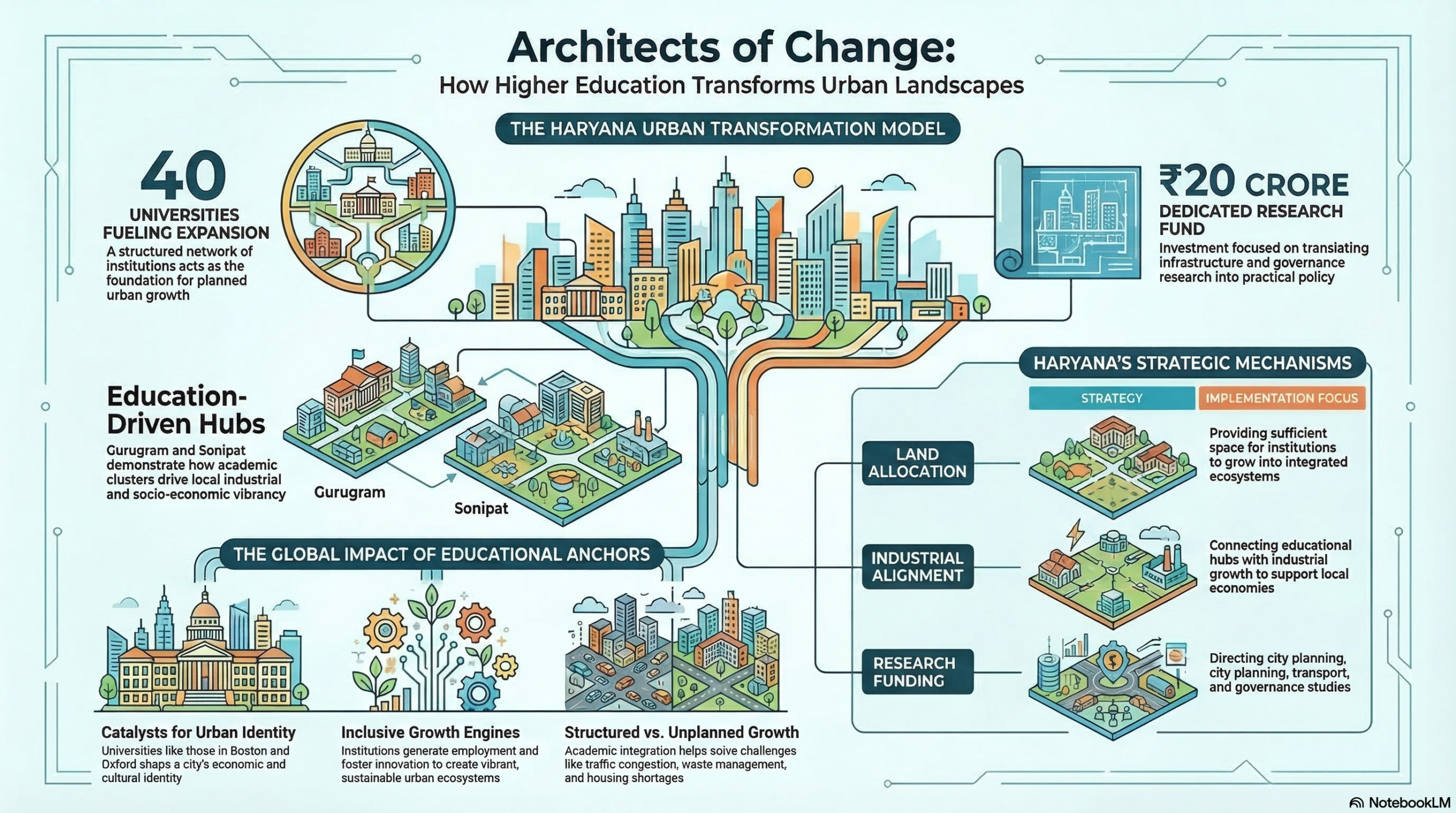
Higher education is becoming an important factor in shaping and improving cities, especially at a time when rapid urbanisation is creating many challenges. Bringing universities and colleges into city planning can help deal with issues like traffic, poor infrastructure, and unplanned growth. In Haryana, efforts are being made to follow this approach by developing education-led ecosystems that support learning while also contributing to economic growth, innovation, and better planned, more sustainable cities.

Across India, rapid and often unplanned urbanisation has led to multiple challenges, including traffic congestion, inadequate waste management, housing shortages, and the proliferation of unauthorised constructions. In contrast, cities like Chandigarh continue to stand out for their structured planning. This contrast highlights the need for a more comprehensive and multi-dimensional approach to urban development, one that can effectively address both present and future challenges.
Higher education institutions are increasingly being recognised as critical enablers in this transformation. Globally, cities such as Boston and Oxford illustrate how universities can shape not just the physical layout of a city, but also its economic, cultural, and social identity. These institutions contribute by generating employment, fostering innovation, and promoting inclusive growth, thereby creating vibrant urban ecosystems.
In Haryana, a well-developed network of nearly 40 universities reflects a structured and planned approach to higher education expansion. Policy frameworks around land allocation ensure that institutions are established with sufficient space, enabling them to grow into integrated ecosystems. The broader vision is to align educational institutions with industrial development, creating education-driven urban hubs that support economic growth while improving overall city planning.

Research and innovation are also being positioned as important tools for urban transformation. The state has allocated dedicated funding of ₹20 crore exclusively for research within the higher education sector. This investment is aimed at supporting studies in areas such as city planning, infrastructure development, transportation, and governance, with a clear focus on translating research outcomes into practical policy interventions.

Also Read: Haryana’s Future-Ready Governance: Building Smart, Resilient, and Inclusive Cities

The impact of this approach is already visible in cities like Gurugram, where the presence of educational institutions has contributed to industrial growth and a dynamic urban ecosystem. Similarly, emerging education hubs in Sonipat, particularly the Rajiv Gandhi Education City, are demonstrating how academic clusters can influence local development, town planning, and socio-economic vibrancy.
Haryana’s outlook remains progressive and collaborative, with a clear openness to new ideas, partnerships, and investments. By strengthening the link between education, research, and urban planning, the state is working towards building resilient, inclusive, and future-ready cityscapes.
Insights shared by: S Narayanan, Director General and Secretary, Department of Higher Education, Government of Haryana, at the 6th Elets Urban Innovation Summit 2026, held on 13th March 2026 at Taj Chandigarh