


As India advances its Digital Public Infrastructure (DPI) ecosystem under the broader vision of AI for All, states are increasingly embedding artificial intelligence into governance frameworks to enhance service delivery, transparency, and inclusion. Karnataka, through the Centre for e-Governance under the Department of e-Governance, is positioning AI as a catalyst for predictive, citizen-centric, and accountable governance aligned with national principles of Safe and Trusted AI.

In this conversation, Shri T Bhoobalan, IAS, Chief Executive Officer, Centre for E-Governance, Department of e-Governance, Karnataka, outlines to Muskan Jaiswal of Elets News Network, the state’s priorities for DPI-led AI integration, focusing on proactive service delivery, unified data intelligence, ethical safeguards, and the development of scalable models such as a Citizen Eligibility Engine that can strengthen whole-of-government outcomes over the next five years.

What are your key AI priorities for strengthening DPI-led governance over the next five years?

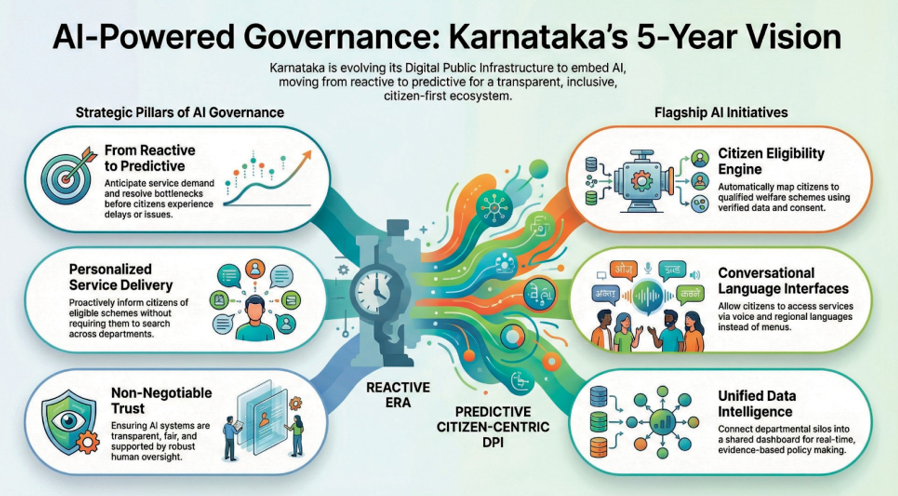
Our focus is to make governance more predictive, personalized, and trustworthy. First, we want to move from reactive to predictive governance, using AI to anticipate service demand and resolve bottlenecks before citizens face them. Second, we aim to personalize services. Citizens should receive information about schemes they are eligible for without having to search across departments.

Finally, trust is non-negotiable. AI systems must be transparent, fair, and supported by strong data protection and human oversight. Technology must enhance trust, not complicate it.

How can AI enhance citizen journeys on platforms like Seva Sindhu?
AI can make services simpler and faster. Through conversational interfaces in regional languages, citizens can describe their needs instead of navigating complex menus.
In grievance redressal, AI can automatically classify complaints, identify recurring issues, and routethem quickly to the right officer— reducing delays.
Most importantly, AI can enable proactive delivery. If the system knows a citizen is eligible for a service, the state should inform them automatically instead of waiting for an application.
How can AI help create a unified, whole-of- government data view?
AI can help us connect data across departments in a secure and structured way. Instead of working in silos, departments can contribute to a shared governance dashboard that provides real-time insights for policymakers.
This enables better targeting of schemes, faster decision-making, and improved monitoring—while ensuring privacy and data security remain central.
Can you highlight one flagship AI initiative with replication potential?
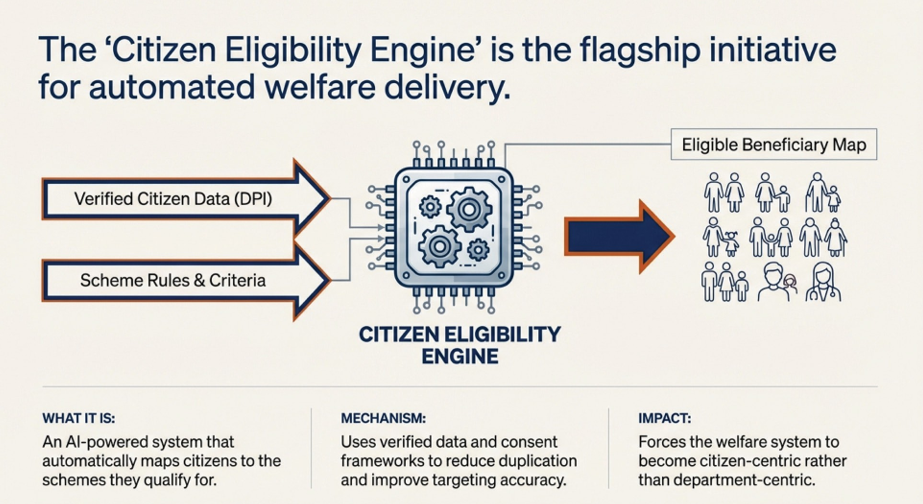
One important initiative we envision is an AI-powered “Citizen Eligibility Engine.” This system would automatically map citizens to the schemes they qualify for, based on verified data and consent frameworks.
It would reduce duplication, improve targeting, and make welfare delivery more citizen-centric rather than department-centric. Because it is built on open and interoperable systems, it can be replicated in other states.
How do you see AI shaping digital governance in Karnataka over the next five years?
AI will make governance smarter, faster, and more inclusive. It will support better policy decisions through data insights, reduce administrative workload through intelligent automation, and improve citizen access through voice and regional language interfaces.
Also Read | Karnataka’s AI Edge: From Talent Powerhouse to Scaled Innovation Hub
In essence, AI will help the state become more responsive and citizen- focused.
Any additional recommendations for building a strong AI ecosystem?
We need three things: strong ethics, quality data, and skilled people. AI systems must be transparent and accountable. Data governance frameworks must be robust. And civil servants must be trained to understand and responsibly use AI tools.
If built responsibly on India’s digital public infrastructure, AI can strengthen democratic governance and improve service delivery at scale.