


In recent years, India has witnessed a digital makeover of the government processes and services, the public sector and the private sector. However, the entire journey of the digital transformation can be broken down into two phases: from physical to digital and from digital to hybrid, writes Adarsh Som of Elets News Network (ENN).

The digital transformation journey of India saw major advancement in the years 2020 and 2021 due to the Coronavirus outbreak. The COVID pandemic-induced lockdowns fast-paced digital adoption as traditional pen & paperwork was no more a choice left. This made governments, public sector units (PSUs), businesses and even citizens shift to online modes for their daily work.

As the lockdowns restricted physical work environments, many software companies came up with collaboration tools, video conferencing software, and other remote technologies to aid remote working. However, as we stepped in 2021 after witnessing the massive move to digital, numerous challenges surfaced and unveiled our unpreparedness for going completely online. Most people, especially in the tier-2 and tier 3 cities and villages lacked access to personal laptops, tablets or smartphones. And, those having the devices faced challenges with internet connectivity. Therefore, the lack of proper IT infrastructure posed a major hurdle. In order to adopt a more inclusive model, most realised that Hybrid is the key to cope up with uncertain scenarios. Besides, the Hybrid model was being promoted by most technocrats, thought leaders and governments as a flexible mode of working and 2021 saw how most made their move to adopt hybrid work environments.

Hybrid: The Future of Work Environments & Education

In general, the hybrid model can simply be termed as an amalgamation of the traditional and online modes. It is a flexible model wherein the work can be done in-person on- field or from a remote location with flexible timings. Therefore, offering better work-life balance, better productivity and efficiency, the hybrid apparently is a win-win situation for either a working professional or a student.

The governments globally have been recognising flexible working models like the hybrid model as the future of e-governance. As per McKinsey Centre for Digital Government 2020, 69 per cent of government IT leaders recognise the growing importance of technology modernisation and 20 percent of governments across the globe would have taken steps aimed at long-term resilience for individuals.
A report from the Economic Times states that the Government of India is working to devise out a legal framework for the new models of work that have resulted out of the pandemic. The framework of the Centre would include the work from home model as well as the hybrid work model where employees would be attending the office for a certain number of days in a week.
Not only the governments but the public and the private sector and educational institutions are also looking ahead to implement a hybrid model.

As per a recent study by Slack, a key reason employees are more drawn to the hybrid work model is ‘flexibility’. Managing the work-life balance certainly becomes easier in a flexible work environment. Apart from this, the fear of getting infected with the COVID is legit as a third wave is expected due to the Omicron variant. Therefore, many people are trying to avoid human contact as a preventive measure and are favouring work from home or the hybrid model.
Although the online model posed a resort to ensure continuity of economic activities amid the lockdown, it is not an inclusive solution as a major chunk of the population is middle class or economically weak and do not have access to the required devices or proper internet connectivity, especially in the rural areas. With the adoption of online modes, the digital divide in the country has been more apparent than any time before and hence needs solutions that are inclusive and sustainable.
The Education sector is also facing the digital divide issue as most government schools’ students in small towns and villages are not privileged enough to have access to the required gear and facilities, hence Hybrid education has been in consideration as an inclusive solution to reshape the future of education in India.
Also Read: Digital Transformation of Governance in India
However, besides the lack of inclusivity, the online mode also raised challenges for the teachers and the institutions. The teachers were required to be reskilled and trained to deliver lectures online with no real-life interaction. On the other hand, schools and colleges have to improve their IT infrastructure and implement management software for the smooth functioning of online classes as well as for recording students’ data.
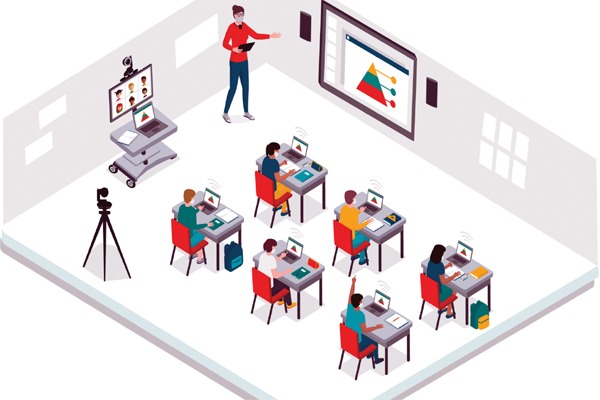
Hybrid Education is being termed as the future of education simply because it is a more inclusive model. Students who wish to attend classes in-person are allowed to do so as teachers teach them in physical classrooms, the same classes are broadcasted on a real-time basis for students who are joining virtually. Therefore, it allows flexibility to a student and makes it easier to cope up with studies and co-scholastic areas of development simultaneously.