
As the India AI Impact Summit 2026 convenes in New Delhi, the world’s most populous democracy unveils an ambitious framework to democratize artificial intelligence, not through Silicon Valley’s playbook, but through digital public infrastructure.
In March 2024, India’s Union Cabinet approved the IndiaAI Mission with an outlay of ₹10,372 crore (approximately $1.25 billion), signaling the country’s most comprehensive attempt yet to position artificial intelligence as public infrastructure rather than private advantage.
Now, as global leaders gather for the India AI Impact Summit 2026, the question is no longer whether India will participate in the AI revolution, but whether it can demonstrate an alternative model, one that prioritizes the last mile over the cutting edge, inclusion over dominance, and democratic governance over technological autocracy.
This isn’t merely aspirational. India’s digital public infrastructure credentials are proven: the Aadhaar biometric identity system covers 1.39 billion residents; the Unified Payments Interface (UPI) processed 118.38 billion transactions valued at ₹199.89 trillion in 2024 alone, according to the National Payments Corporation of India; and the CoWIN platform managed over 2.2 billion COVID-19 vaccine doses, as reported by the Ministry of Health and Family Welfare.
The Summit arrives at what organizers are calling a “civilizational inflection point”, a moment when AI’s trajectory could either amplify existing inequalities or fundamentally reshape opportunity structures for the Global South.
A Global South First

The India AI Impact Summit 2026 positions itself as “A Global South First”, explicitly centering perspectives from nations facing similar constraints: limited compute infrastructure, multilingual populations, resource scarcity, and development urgency. This framing is deliberate. The global AI landscape reveals stark asymmetries that India’s strategy directly confronts.
Stanford University’s 2024 AI Index Report shows the United States and China account for over 80% of global private AI investment. The top 10 AI companies by market capitalization are headquartered in just three countries. Advanced GPU clusters required for frontier model training are overwhelmingly concentrated in North America, with secondary concentrations in China and Europe, according to the 2023 State of AI Report.
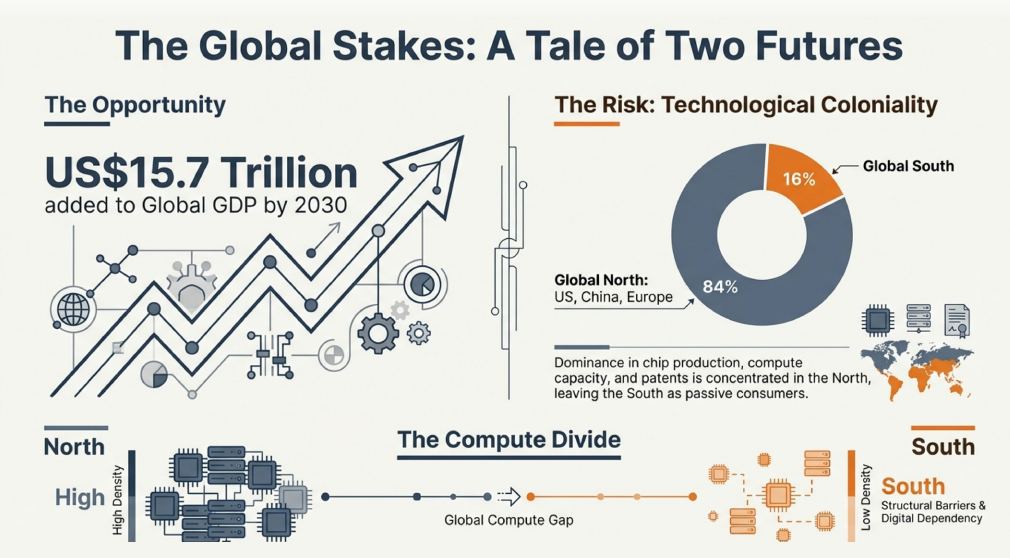
India, despite its software prowess, remains largely dependent on imported semiconductor technologies and cloud infrastructure controlled by foreign entities. The Union Budget 2026, presented just weeks before the Summit, allocated an additional ₹25,000 crore for semiconductor manufacturing and AI compute infrastructure, signaling government’s commitment to addressing strategic vulnerabilities. However, the India Semiconductor Mission, established in 2022 with initial incentives worth approximately ₹76,000 crore ($10 billion), received further impetus with the budget announcement of expedited approvals for fabrication facilities. As of early 2026, three major semiconductor proposals entered advanced stages of evaluation, with the first fabrication facility expected to begin construction by late 2026, a timeline that, while ambitious, reflects India’s urgency in building foundational AI infrastructure.
India held the G20 Presidency in 2023, during which it helped advance consensus on AI principles through the New Delhi Leaders’ Declaration, adopted in September 2023. The country also co-chairs working groups on responsible AI and the future of work in the Global Partnership on AI (GPAI). The Summit builds on this diplomatic groundwork, transforming principles into actionable frameworks.
The Three Sutras: Philosophical Architecture
As Summit participants explore India’s AI vision, they encounter what policymakers term the “Three Sutras”, philosophical pillars that differentiate India’s approach from dominant Western and Chinese models.
The People Sutra addresses India’s core challenge: making technology accessible across massive literacy, linguistic, and economic variation. According to the 2011 Census, India’s literacy rate stood at 74.04%, with significant gender disparity, 82.14% for males versus 65.46% for females. The Census identifies 121 languages spoken by more than 10,000 people each, while the Linguistic Survey of India has documented over 780 languages. India’s Bhashini platform, developed under the National Language Translation Mission, provides AI-powered translation across multiple Indian languages, enabling voice- based interfaces that bypass literacy barriers, critical when approximately 330 million adults have limited literacy, yet 850 million people own smartphones.
The Planet Sutra reflects India’s climate vulnerabilities.
The country ranks seventh globally in climate risk (Global Climate Risk Index 2021, Germanwatch). Research in Nature shows that training large language models emits carbon equivalent to multiple transatlantic flights, challenging for India, committed to 500 GW renewable energy capacity by 2030. Yet AI also enables climate adaptation: the India Meteorological Department reports cyclone track prediction errors decreased from approximately 200 km in the 1990s to under 60 km for 72-hour forecasts currently.
The Progress Sutra connects AI to economic development and poverty alleviation. India lifted 271 million people out of multidimensional poverty between 2005-06 and 2019-21 (UNDP/Oxford Poverty and Human Development Initiative, 2023). India’s GDP growth was 7.2% in FY 2022-23 (Ministry of Statistics). The Economic Survey 2023-24 projects AI could add approximately 15-20% to GDP by 2035. The Progress Sutra focuses on ensuring AI reaches the bottom of the pyramid—farmers, small enterprises, rural healthcare workers.
The Summit showcases how these principles translate into seven operational domains, termed “Chakras”, addressing critical components of India’s AI ecosystem.
Human Capital tackles the skills gap. India produces approximately 1.5 million engineering graduates annually (AICTE), yet NASSCOM’s 2023 report indicates only 25% possess job-ready AI skills. FutureSkills PRIME enrolled over 500,000 learners as of late 2024. TCS plans to train 450,000 employees in AI/data science by 2026; Infosys is committed to upskilling approximately 350,000 employees. Yet TeamLease EdTech estimates India needs approximately 1 million AI professionals by 2026, a gap that current initiatives have not yet closed.
Inclusion for Social Empowerment addresses India’s digital divide. TRAI reported 1.16 billion wireless subscribers (December 2024), but IAMAI-Nielsen found urban internet penetration at 96% versus rural at 46%; women trail men by approximately 15 percentage points. UPI’s voice-enabled payment features (2023) allow transactions in multiple Indian languages. PM-WANI deployed over 450,000 public Wi-Fi hotspots, though concentrated in urban areas.
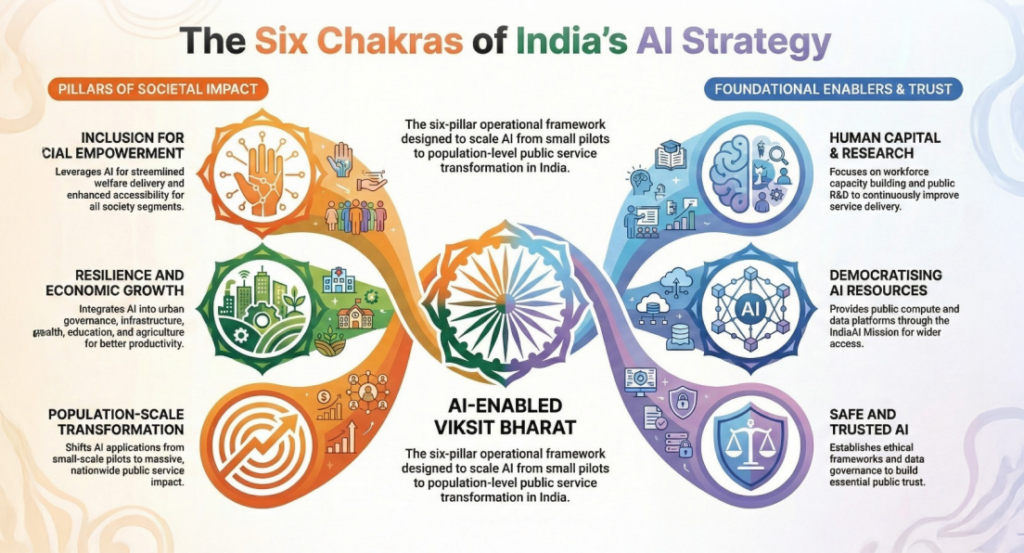
Safe & Trusted AI emerged as an urgent priority during the 2024 general election (968 million eligible voters). Fact- checking organizations documented thousands of deepfake videos. The Digital Personal Data Protection Act (2023) establishes consent-based frameworks. A 2024 IIT Delhistudy found deepfake detection models trained on Western datasets showed significantly reduced accuracy on Indian faces and languages—highlighting needs for contextually appropriate tools.
Resilience, Innovation & Efficiency applies AI to disaster management and urban governance. NDMA estimates approximately 60% of India’s landmass is prone to earthquakes, 40 million hectares to floods, and 5,700 kilometers of coastline to cyclones. Bengaluru’s BBMP deployed computer vision for pothole detection (2023), identifying over 15,000 road defects within six months. Mumbai’s BMC piloted AI-enabled traffic management. Surat’s smart city initiatives include AI-powered solid waste management, though scaling from pilots to citywide implementation faces funding and coordination challenges.
Science focuses AI on India’s specific research priorities. WHO’s Global Tuberculosis Report 2024 shows India accounted for approximately 27% of global TB cases in 2023—2.8 million cases. ISRO’s Chandrayaan-3 landing (August 23, 2023) made India the fourth nation to achieve a soft lunar landing. The National Supercomputing Mission (DST-MeitY, 2015) established high-performance computing facilities at 25 institutions. Yet a 2023 Centre for Internet and Society analysis found AI research publications from Indian institutions represent approximately 3-4% of global output.
Democratizing AI Resources challenges the concentration of AI capabilities within large corporations. The IndiaAI Mission includes GPU-based computing resources accessible to researchers, startups, and government agencies. As of early 2025, procurement processes were underway, with operationalization expected through 2025-26. The IndiaDatasets platform aims to aggregate public datasets across domains, though data quality varies significantly.
AI for Economic Growth & Social Good translates infrastructure into sectoral impact. Agriculture employs approximately 42% of the workforce but contributes around 18% to GDP. Kisan Call Centers handled over 16 million queries in 2023-24. The Pradhan Mantri Fasal Bima Yojana covered approximately 34 million farmers in 2023-24. In healthcare, the National Health Profile 2023 shows a doctor-population ratio of approximately 1:834 (against WHO’s 1:1000), with only 37% of doctors serving rural areas, housing 65% of the population. Ni-kshay Poshan Yojana integrated AI-powered chest X-ray analysis at approximately 5,000 facilities. With an estimated 77 million diabetics (International Diabetes Federation, 2021), AI screening tools processed hundreds of thousands of retinal scans. Yet a 2024 Lancet Regional Health – Southeast Asia study found real-world implementation in resource-constrained health centers faced challenges, including unreliable electricity, inadequate connectivity, and limited technical training.
What Works: Lessons From Implementation
Summit presentations on successful deployments reveal five patterns. First, leveraging existing digital infrastructure, building on UPI and Aadhaar rather than creating parallel systems. Second, solving high-impact, narrow problems, well-defined problems with measurable outcomes. Pothole detection proves more tractable than complete traffic management; TB screening is more achievable than general diagnostic AI. Third, public-private partnerships, combining government program management with private technical expertise, as CoWIN demonstrated. Fourth, language and cultural contextualization, tools designed for Indian contexts outperform adapted foreign technologies. Fifth, iterative deployment, phased rollouts with feedback loops, starting with pilot districts before national scaling.
The Road Ahead: From Summit to Scale
The India AI Impact Summit 2026 occurs at an inflection point, where policy frameworks meet implementation realities, where global principles encounter local constraints, and where aspiration faces the test of scale.
India’s approach differs from alternatives not primarily in technology but in political economy. Where American AI development concentrates in corporations optimizing for shareholder returns, and Chinese AI serves state strategic objectives with limited public accountability, India attempts AI as democratic public infrastructure—accountable to citizens, accessible across social strata, and oriented toward inclusive development.
Whether this model proves viable remains uncertain. The challenges are formidable: limited fiscal resources, infrastructure constraints, capacity gaps, and the inherent difficulty of governing complex technologies through democratic processes. Yet India’s digital public infrastructure achievements suggest the model is not merely theoretical. UPI demonstrates that systems can achieve massive scale while remaining open, interoperable, and accessible. Aadhaar shows that a complex identity infrastructure can span a billion-plus population. CoWIN proved that mission-mode deployments can succeed despite resource constraints.

The question for India’s AI strategy is whether these successes can extend to artificial intelligence, a technology more technically complex, more ethically fraught, and more economically consequential than previous digital platforms.
The Summit’s focus on “impact” rather than innovation signals a deliberate priority shift: from celebrating pilots to demanding outcomes, from technology showcases to measurable improvements in citizen lives, from global race narratives to development imperatives.
For the Global South watching India’s experiment, the stakes extend beyond any single country. If AI can be deployed at scale within democratic constraints, addressing development priorities while respecting rights and pluralism, it offers an alternative to techno-authoritarianism or market concentration.
The Seven Chakras provide architecture. The Three Sutras offer philosophy. What remains is execution, converting frameworks into functional systems, policies into programs, and aspirations into algorithms that genuinely serve 1.4 billion people.
That is the promise and the test that the India AI Impact Summit 2026 places before the world.