
Gujarat today stands at the crossroads of tradition and transformation, weaving its historic role as India’s gateway of trade with an ambitious vision for future mobility. From the hum of electric buses on city streets to the silent glide of cargo across green shipping corridors, the state is reimagining how people and goods move. Its strategy is not limited to laying roads or modernising ports—it is about creating an ecosystem where mobility becomes seamless, sustainable, and smart.
With India setting bold targets for electric vehicles, renewable energy, and logistics efficiency, Gujarat has positioned itself as a frontrunner. It is one of the top three states in EV adoption, home to pioneering policies such as the Gujarat EV Policy 2021, and a preferred destination for auto and battery manufacturers. Its ports handle nearly 40% of India’s cargo volume, while world-class airports and expanding metro networks are redefining urban connectivity. The Gujarat State Road Transport Corporation (GSRTC) is embracing digital ticketing and electric buses, while multimodal integration links highways, railways, and waterways in unprecedented ways.
This is the story of Gujarat in motion—where innovation meets infrastructure, and where green mobility fuels both growth and global competitiveness.
Roadways & Public Transport: GSRTC and Beyond
Few public transport systems in India carry the weight of scale, inclusivity, and innovation like the Gujarat State Road Transport Corporation (GSRTC). With a formidable fleet of 8,703 buses, connecting 99.3% of Gujarat’s 18,676 villages, and ferrying nearly 25 lakh passengers daily, GSRTC has long been the state’s mobility lifeline. But what sets it apart today is its ongoing transformation—from a conventional transport operator into a forward-looking, sustainability-driven, and technology-enabled organisation.
At the operational level, GSRTC delivers staggering efficiency: averaging 32.5 lakh kilometres daily across 47,462 trips, maintaining a 69.5% load factor, and achieving one of India’s lowest breakdown rates at 0.01 per 10,000 km. This is enabled by predictive maintenance, AI-driven load optimisation, and GPS-enabled tracking that ensure punctuality and reliability.

On the green mobility front, GSRTC is embedding sustainability into its reach. Electric buses are being introduced across highdensity corridors like Ahmedabad, Surat, Vadodara, and Rajkot, with dedicated green corridors planned in tourism zones and industrial hubs. This aligns seamlessly with Gujarat’s EV Policy 2021 and the state’s ambitious target of 20 lakh EVs by 2030.
The corporation’s modernisation drive has seen the induction of 19,943 new buses at an investment of ₹4,644.5 crore, upgrading services with AC coaches, luxury buses, and CNG variants. Digital innovation is also a hallmark—GSRTC pioneered GPS/ PIS-based tracking, e-ticketing, and is now moving toward QRbased smart ticketing integrated with UPI and NCMC.
Also Read | Gujarat’s Green Energy Revolution – Pioneering India’s Sustainable Energy Transformation
Beyond efficiency and technology, GSRTC embodies social impact—initiatives like free travel for village girl students, concessional passes, and enhanced luggage allowances directly empower communities and contribute to the vision of Viksit Bharat.
From digital-first operations to green fleet transition, GSRTC is proving that public transport can be more than mobility—it can be the backbone of sustainable growth, equity, and innovation.
Electric Vehicle Revolution: From Policy to Production
Surging Sales & Demand
Gujarat’s EV journey is backed by striking statistics. EV registrations have soared from about 7,240 to 1,18,086 in just two years—a remarkable 1,475% surge. Monthly averages hit 8,858 new EV registrations, signaling accelerating adoption. Cities like Surat (31,561), Ahmedabad (20,937), Vadodara (7,648), Rajkot (6,678), and Jamnagar (3,259) are leading this charge, spanning two-wheelers, three-wheelers, four-wheelers, and others.
This aligns with earlier trends: EV sales climbed 28% to 88,619 units in 2023, reflecting a 714% increase since 2021.
Policy Engines: The Gujarat EV Policy 2021 laid the groundwork with incentives
- Demand subsidies: up to 20,000 (2W), 50,000 (3W), 1.5 lakh (4W).
- Capital subsidy for first 250 public charging stations: 25% (up to 10 lakh each); plus 100% electricity duty waiver.
- Vehicle registration fee exemption and manufacturinglinked incentives under Industrial Policy 2020.
Manufacturing Powerhouse
Gujarat has firmly positioned itself as India’s electric vehicle (EV) and mobility manufacturing hub, hosting marquee investments and plants from global and domestic giants:
- Tata Motors (Sanand Plant): Acquired from Ford for ₹725.7 crore, this facility adds a capacity of 300,000 units annually, scalable to 420,000 units, and is a major production site for the Nexon EV and other models.
- Maruti Suzuki / Suzuki Motor Gujarat (Hansalpur): The newly launched e-Vitara plant in Hansalpur marks Maruti Suzuki’s serious entry into the EV segment. The company is committed to launching its first EV by 2024–25 and targets an ambitious product mix of 15% EVs and 25% hybrids by 2030–31.
- MG Motors (Halol): EV production is underway at its Halol plant, with a ₹5,000 crore expansion plan for a second facility to meet rising domestic and export demand.
- Battery Manufacturing Backbone: Gujarat also anchors India’s battery ecosystem. TDSG (Toshiba–Denso– Suzuki) established the state’s first lithium-ion battery facility, while the Tata Group is investing ₹13,000 crore in a 20 GWh battery plant, reinforcing the supply chain for EV manufacturing.
Charging Infrastructure & Startups
- Public charging stations increased from ~200 to over 600, now reaching Tier-2 towns and highways.
- GUVNL plans 250 more stations; private players like Tata Power, HPCL, IOCL, Adani Total, and Torrent Power are involved.
- Startups and incubators like WardWizard (battery assembly in Vadodara), Odysse EV, Triton EV, and EVfocused deep-tech firms are energising innovation.
These combined forces are making Gujarat not just a manufacturing hub but an innovation engine for India’s EV ecosystem.
Waterways & Logistics: Green Ports and Masterplans
Port Efficiency & Sustainable Handling
Mundra Port
India’s largest private commercial port and a flagship of Adani Ports, Mundra handles more than 155 million tonnes per annum (MTPA) of cargo. It is a multipurpose deep-draft port with dedicated terminals for containers, coal, crude, and automobiles. Mundra is also a leader in port-led industrialization, hosting SEZs, refineries, and logistics hubs. Sustainability initiatives include solar and wind energy integration and eco-friendly cargo handling.
Dahej Port
A key bulk-handling port under Adani Ports, Dahej manages 20 MTPA, with world-class conveyor systems minimizing dust pollution. It also has a Ro-Ro terminal and strong connectivity through rail and NH-8, making it a major node for industrial cargo, including coal, fertilizers, and petrochemicals.
Hazira Port (Surat)
Hazira, another Adani Ports facility, acts as a gateway to South Gujarat, handling containers, liquid, and bulk cargo. It’s a deep-water, all-weather port connected to the Delhi– Mumbai Industrial Corridor (DMIC). Hazira is crucial for supporting petrochemicals and heavy industries in the Surat–Hazira belt.
Pipavav Port (Amreli District)
One of India’s first private sector ports, Pipavav (operated by APM Terminals) handles containers, liquid, bulk, and Ro-Ro cargo. With a capacity of 1.35 million TEUs annually, Pipavav is known for efficient container logistics and direct connectivity to the Western Dedicated Freight Corridor (DFC).
Kandla (Deendayal) Port, Gandhidham
One of India’s major government ports, Kandla specializes in liquid cargo (oil and petroleum), grains, and chemicals, handling over 115 MTPA. It remains a backbone of India’s crude oil imports and plays a pivotal role in Gujarat’s strategic energy logistics.
Logistics Masterplans
The Gujarat Infrastructure Development Board (GIDB) is preparing city-level logistics masterplans across eight key cities, backed by a ₹500 crore investment. These plans will focus on freight corridors, urban logistics parks, and ULIP integration, aligning with PM Gati Shakti to reduce bottlenecks and improve Gujarat’s LEADS survey ranking.
Sagarmala Alignment
Under the Sagarmala Programme, Gujarat is set to benefit from 279 projects nationwide, with 114 port-rail links and 1,675 km of rail already completed. These will integrate Gujarat’s ports into a seamless multimodal grid, boosting EXIM trade, domestic supply chains, and green shipping corridors.
Aviation & Airport–Transit Integration
Air Connectivity Expands
Gujarat already hosts multiple key airports: four international (Ahmedabad, Surat, Rajkot Int’l, Vadodara), eight domestic, two private, and three military bases. Three new airports (Dholera, Ankleshwar, Deesa) are under development. GUJSAIL is streamlining civil aviation growth.
Rajkot International Airport (Hirasar)
Inaugurated in July 2023 and operational since September, Rajkot Airport handles 1,088,570 passengers (+107%), 8,294 aircraft movements, and 608 tonnes of cargo (+132.9%) in FY 2024–25. State-of-the-art with green features—it supports widebody jets and showcases Gujarat’s modern airport infrastructure
Dholera International Airport (greenfield)
Set to operate by December 2025/26, this India–Gujarat joint venture will support the Dholera SI investment region and the DMIC corridor. With ₹987 crore in Phase 1 planning and construction underway, it features a 3,200 m runway, cargo complex, and terminal facilities.
These projects are set to transform regional air connectivity, integrate transit systems, and support economic zones.
Rails, Metro & Multimodal Integration
While Gujarat’s metro network is presently concentrated in Ahmedabad, the state’s vision for seamless mobility goes far beyond city limits. The government is strategically investing in a multimodal transport ecosystem that combines rail, road, air, and sea connectivity to accelerate passenger and freight movement.
Also Read | India’s transition to electric mobility
Ahmedabad Metro
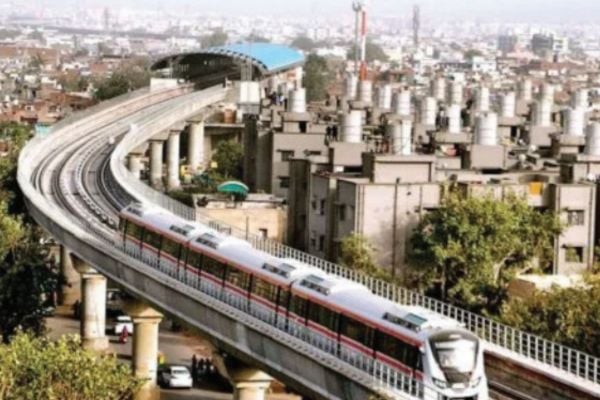
The Ahmedabad Metro continues to expand, and there are proposals to extend metro connectivity to Gandhinagar and Surat, positioning these urban centers as future hubs of rapid urban transit. On the national integration front, Gujarat is a critical node in the Dedicated Freight Corridor (DFC), which is transforming industrial logistics by enabling faster, more reliable cargo movement.
In A Nutshell
Gujarat’s mobility revolution is more than a story of roads, rails, and runways—it is a story of vision, resilience, and reinvention. By electrifying fleets, modernising ports, expanding metro corridors, and weaving AI into transport systems, the state is demonstrating how infrastructure can fuel both growth and sustainability. With EV adoption surging, airports redefining green connectivity, and GSRTC setting benchmarks in public transport, Gujarat is not merely keeping pace with India’s ambitions—it is shaping them. The state stands as a living blueprint of how mobility, when made smart and sustainable, becomes the true engine of inclusive progress.