
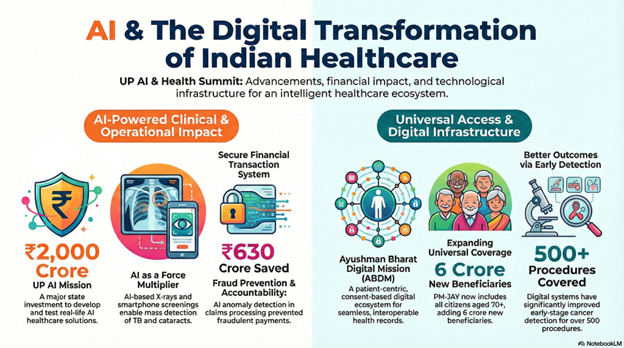
The recent UP AI and Health Summit represents a critical inflection point for India’s digital health maturity, serving as a strategic catalyst for a national healthcare transformation. By situating the announcement of the ₹2,000 crore UP AI Mission within the broader context of India’s technological sovereignty, the summit signals a decisive shift toward integrating artificial intelligence into the core of public service delivery. As a vital precursor to the upcoming AI Impact Summit in February, the event established a high-level forum for technical discourse and cross-state collaboration. For health-tech innovators, the summit clarifies the pathway to accessing high-quality, real-world datasets, while for state administrators, it offers a blueprint for leveraging AI to generate actionable intelligence and strengthen systemic capacity. This regional momentum is the opening chapter in a larger narrative of a national digital infrastructure designed to sustain these innovations at scale.
1. The Digital Backbone: NHA, PM-JAY, and the ABDM Ecosystem
The National Health Authority (NHA) functions as the strategic architect of India’s healthcare evolution, establishing a unified, scalable IT framework that prevents the fragmentation of digital health services. This “National Vision” explicitly discourages isolated state solutions, instead providing a common platform where states can onboard their specific schemes to benefit from shared digital assets. The NHA manages this transition through a dual-mandate approach: the Ayushman Bharat Pradhan Mantri Jan Arogya Yojana (PM-JAY) for health assurance and the Ayushman Bharat Digital Mission (ABDM) for the underlying digital infrastructure.
The ABDM ecosystem is anchored by three transformative pillars:
- Open and Interoperable Infrastructure: Utilizing a “federated” data model, the architecture ensures that health data remains at the source rather than in a central repository, with access granted only through secure, standardized protocols.
- Patient-Centricity: The framework centers on the Ayushman Bharat Health Account (ABHA) ID, which facilitates a robust, consent-based data-sharing mechanism, ensuring patients maintain agency over their personal information.
- Longitudinal Health Records: By enabling the secure movement of records across disparate providers, the system builds a comprehensive health history for every citizen. This longitudinal view is critical for shifting the paradigm from reactive treatment to predictive and preventive care.
This robust digital infrastructure is the fundamental prerequisite for achieving superior clinical outcomes, particularly in the realm of early disease detection.


2. Clinical Impact: AI as a Force Multiplier in Specialised Care
From a health-economic perspective, the transition toward early detection and preventive care is a clinical necessity to mitigate long-term systemic costs. The efficacy of this shift is most evident in cancer care; data from the Economic Survey 2024–25 indicates that PM-JAY has fundamentally altered patient behavior by covering over 500 cancer-related procedures. This financial cushion has shifted the public narrative from “catastrophic fear” of a diagnosis to proactive health-seeking behavior, particularly among underprivileged populations who now access care at earlier, more treatable stages.
In a country with a significant doctor-to-patient ratio deficit, AI acts as a “force multiplier,” allowing the existing workforce to manage a vast and diverse population with higher precision and clinical effectiveness.
AI-Driven Healthcare Interventions
| Technology/Application | Impact on Clinical Capacity |
| AI-based X-ray Analysis | Automates mass screening and enables rapid triage for Tuberculosis in high-burden areas. |
| Smartphone-based Screening | Decentralises diagnostic capabilities, allowing ASHAs to detect Cataracts at scale in remote settings. |
| Clinical Decision Support (CDS) | Standardises care protocols and enhances the diagnostic accuracy of frontline workers and clinical staff. |
These technological “force multipliers” are essential to addressing the unique scale and diversity of the Indian population, ensuring that quality care is not limited by geographic or human-resource constraints.
3. Institutional Integrity: Fraud Detection and Responsible AI Deployment
The integration of AI into public health demands a dual focus: utilising the technology as a tool for systemic accountability while subjecting the algorithms themselves to rigorous validation. The NHA has successfully deployed AI-based anomaly detection within claims processing to safeguard public funds. This proactive stance has already prevented approximately ₹630 crore in fraudulent claims under PM-JAY, instilling a culture of accountability among providers and ensuring resource optimisation.
However, clinical safety is as vital as financial integrity. To ensure “Responsible AI” deployment, the NHA is collaborating with IIT Kanpur to develop an AI testing and benchmarking platform. This initiative addresses the risk of “algorithmic bias” by testing solutions against large, diverse Indian datasets rather than localized or limited ones. By validating technologies through national-level hackathons and rigorous benchmarking, the NHA ensures that AI interventions are both safe and effective for the entire population. These institutional safeguards provide the necessary trust framework as the mission transitions from pilot phases to widespread operational adoption.
4. Scaling the Vision: Universal Coverage and the Road to 2026
India’s strategic trajectory is moving toward Universal Health Coverage (UHC), characterised by a radical expansion of the beneficiary base. PM-JAY has recently evolved to include all citizens aged 70 and above regardless of socio-economic status, alongside the inclusion of ASHA and Anganwadi workers. This expansion is made operationally feasible through the flexibility of the NHA platform, which integrates Aadhaar-seeded databases such as the National Food Security Act (NFSA) records and state-specific family databases. Currently, 13 states are nearing universal coverage by onboarding their local schemes onto this unified national IT backbone.
Despite this progress, significant interoperability hurdles remain. The path to 2026 requires addressing three primary challenges:
- Data Standardisation: Accelerating the generation of “structured electronic medical records” (EMRs) to provide the high-quality data AI requires for clinical precision.
- Private Sector Integration: Incentivising private hospitals to adopt the National Health Claims Exchange (NHCX) to ensure a seamless, paperless claims experience.
- Systemic Adoption: Encouraging both public and private facilities to transition fully to ABDM-enabled Hospital Management Information Systems (HMIS).
The NHA’s 2026 vision is to “leapfrog” the expensive, siloed, and legacy-burdened health systems of the West by building a natively digital, federated ecosystem. The goal is a transition from simple health insurance to “intelligent health assurance”—a system that is more integrated, predictive, and fundamentally patient-centric.
Insights shared by: Dr. Sunil Kumar Barnwal, IAS, CEO, National Health Authority, Government of India at the recently concluded UP AI & Health Innovation Conference in Lucknow.