


Data Driven Decisions: ‘Education intelligence’
Typically school districts have been the repository for detailed data about students and schools and the obligation has been to report aggregate data to their state education agency (SEA). The SEA then reports statistical summaries the federal level. The No Child Left Behind Act (NCLB) has dramatically increased the amount of data needed to comply with federal mandates and the need for more sophisticated data systems is upon us all. At the heart of the new systems is the need for States to have access to record-level student demographic and assessment data to help drive decision making.

 In order to realize these benefits, state education agencies need to engage efficient and effective systems for local education agencies to report state-required data as well as an automated, streamlined process for reporting federally required data. The system that satisfies this need is a data warehouse that is built on standards of interoperability. The data warehouse process assembles a separate database holding copies of data from a wide array of different sources. The data are extracted, cleansed, standardised and deposited into the data warehouse. This system makes data available to the decision making process for analysis and reporting. It is important that questions can be posed to the decision making process in real time and the data warehouse deliver immediate results. Education Intelligence is something educators and administrators apply every day. A data warehouse is a powerful tool for extending that intelligence.
What kind of data belongs in a school district data warehouse?

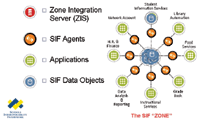 Data pertaining to student demographics, grades, student schedules, attendance and discipline; standardised test data including item analysis capability; state test results; teacher information and student extracurricular activities and programs are ideal candidates for a meaningful data warehouse. Student information that would lead to quick identification of all students in all grades that would benefit from Academic Intervention Services and to follow their progress while receiving services is a core benefit.

Getting the Data: The Schools Interoperability Standard (SIF) Backbone

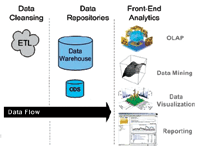 Policymakers and educators need data warehouse systems capable of providing timely, valid and relevant data. Access to these data gives teachers the information they need to tailor instruction to help each student improve. It also gives administrators the resources and information to effectively and efficiently manage programmes, and evaluate which policy initiatives show the best evidence of increasing student achievement.

SIF is recognised an important methodology in addressing the challenges posed by disparate IT systems and is a critical step toward improving access to necessary information. SIF is an industry-supported open standard that allows schools, districts, and states to use compliant applications for managing a wide variety of data.
Data Warehouse Methodology
Data Warehousing is open to an almost limitless range of definitions. Simply put, Data Warehouses store an aggregation of an education data. Each education system is unique and the organisation will influence the data warehouse, however there is a common thread of design and methodology that is dictated by common mandates, identification of pockets of need, and NCLB reporting.
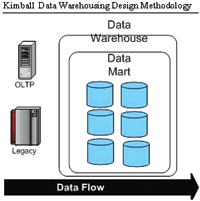 The two major design methodologies of data warehousing are based on the work of Ralph Kimball and Bill Inmon. Both Kimball
and Inmon view data warehousing as separate from OLTP (online transaction processing) and legacy applications.
Kimball views data warehousing as a constituency of data marts. Data marts are focused on delivering business objectives for parts of the organisation. And the data warehouse is a conformed dimension of the data marts. Therefore, a unified view of the education system can be obtained from dimension modeling on a local level.
Any data warehouse solution must fully support SIF interoperability to be a viable and capable of presenting data on demand
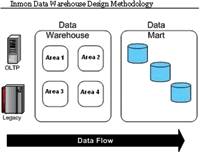
Inmon suggests creating a data warehouse on a subject-by-subject area basis. Therefore the development of the data warehouse can start with data from data stores and other areas can be added to the data warehouse as their needs arise. Data flows from the data warehouse to separate data marts.
In general, for most purposes, it can be difficult to obtain a unified view of the overall system at both the local and administrative level using the Inmon model and CORE-ECS subscribes to a data warehouse model based on a collection of data marts integral to the warehouse.
Data Warehouse Vision: A partnership of opportunity.
 The complex task of pulling together information from divergent sources to create a data warehouse has previously been a deterrent to many education agencies. CORE-ECS has joined forces with Computer Power Solutions of Illinois (CPSI) to bring education agencies end-to-end data integration and warehousing tools based on SIF and data driven education intelligence. CORE-ECS has developed eD3 (ee-dee cube), a comprehensive data warehousing
solution designed especially for state agencies and school districts. eD3 gives education agencies the informational power to accurately answer questions that were once a vague interpretation of data or intuition. eD3 is a comprehensive SIF-compliant data warehouse solution that centralizes education data to support the decision-making process. The superior SIF capability of CPSI coupled with the unparalleled CORE-ECS data querying and reporting tools make eD3 a proven, architecture for data driven decision making to support.
Portal Services
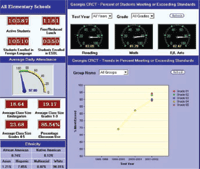 The eD3 Portal is a configurable interface that is the central entry point to all eD3 features and functions. It serves as the launch point for ETL tools, report creation (CORE-ECSReports) and data analysis (CORE-ECSDTool). It can contain the CORE-ECSDashboard, which is a customizable web page that showcases
real-time data, such as attendance and performance, in various graph formats. The main interface can be designed to look similar to a district’s or state’s own website.
eD3 Delivers on Better Data
The eD3 is a proven SIF-based data warehouse solution combined with a robust, data mining, and reporting capability. Multiple users can access databases without making permanent changes to the data. Access to particular fields can be given to or restricted from groups of users. Together, these attributes provide outstanding support for an efficient and flexible district-wide or state-wide architecture.
The architecture provides many features that enable customers to respond to change rapidly. Its n-tier structure allows for development and modification of individual components, including the introduction of new technologies (or the replacement of outmoded ones) in each tier, with minimal impact on components provided by other tiers.