


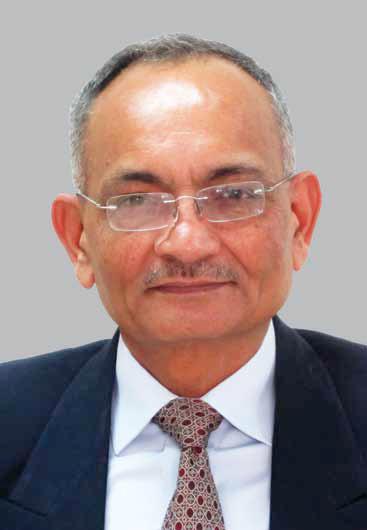
 Brig. Rumel Dahiya
SM (Retd.), Deputy Director General,
Institute for Defence Studies and Analysis (IDSA)

“Main achievement of IDSA is to nurture talent; many scholars who have passed through the portals of IDSA have joined various arms of the government and the universities,” says Brig. Rumel Dahiya
Please tell us about the mandate of IDSA. In your opinion, how far has IDSA succeeded in fulfilling its mandate over the years?

Institute for Defence Studies and Analyses (IDSA) was established as a registered society in New Delhi on November 11, 1965; at that time the need was felt in the government for a research unit. The mission of IDSA was to provide objective assessments of issues relating to national and international security. The initiative for setting up the Institute came from then Defence Minister
Shri Yeshwantrao Chavan, who was one of the Institutes’s founding members. Mainly IDSA has been established with the objective of providing strategic policies in a well-structured manner so that the government pick up ideas that are worth implementing. Over the last forty-plus years, IDSA has played a crucial role in shaping India’s foreign and security policies, including those with respect to nuclear weapons, military expenditure, and conventional and non-conventional threats to India.

In our opinion, what were the main achievements of IDSA during the last 40 years?

Main achievement of IDSA is to nurture talent; many scholars who have passed through the portals of IDSA have joined various arms of the government and the universities. Our scholars have been writing in large number of books, periodicals, etc. IDSA also writes on strategic issues concerning the nation’s security and policy. These too have been well received by the government and the reading public. So another notable contribution made by IDSA is the awareness on strategic issues that have been created. The government too has benefitted from the policy inputs that have come out of IDSA. IDSA is funded by the Indian Ministry of Defence. It functions autonomously.

The core values that serve as IDSA’s guiding principles
• Integrity and Honesty
• Commitment
• Professionalism
• Pursuit of excellence
• Teamwork
• Innovation and Creativity
What is the view of IDSA on the security situation in Indian subcontinent? What are the major challenges that the Indian defence forces face?
In IDSA the scholars are free to carry out their own detailed research and then come out with their own views for debate and public discussion. However, in my opinion, the security situation in the region continues to be unstable. All the countries in the region are facing external or internal problems. The greatest challenge that the subcontinent faces is that of development deficit. Poverty, threat of terrorism and interference from outside the region are causes for concern. The most major challenge before us is one of development. Peace can only be there when there is sufficient development. So we have work towards developing trust within neighbours and come up with ideas that enable the entire region to grow out of poverty, unemployment and internal conflicts.
Has IDSA done research on how ICT is nowadays proving critical for the success of military missions?
IDSA through its publications and lecture series has been highlighting the use of the ICT in warfare. In fact, ICT is important not only from the perspective of warfare but also for public good in general. Through ICT we can bring about an improvement in the delivery system, we can remove corruption – all these are the focus areas for IDSA. I would also like to point out that recently we have started working on the area of cyber security, which is a growing challenge not only from military point of view but also from the public services point of view. Lot of damages can be done by cyber attacks on our critical infrastructure; classified data can be stolen from the computers owned by our organisations. Many sensitive installations have already been targeted by foreign entities. IDSA has taken out its cyber security report, which has been well received. We are taking the issues related to ICT in warfare and the cyber security related concerns very seriously.
The fact is that technology is changing at a very fast pace. In a very short span of time many new versions of the same technology become available. What strategy should Indian armed forces use for implementing the best possible technology?
IDSA doesn’t focus on technical aspect of ICT. There is neither the mandate nor do we have technically qualified manpower to take the lead in this area. Our concern basically is to highlight the need for paying attention to it. The armed forces have to choose new technology after evaluating all the pros and cons. A technology can lead to better targeting, better surveillance, better resource management, etc., but it’s very sophistication might also harbour the seeds of vulnerability. It might be prone to hacking. This is the dilemma. If you don’t use technology, you run the risk of failing to deploy your resources, but if you use it, you become vulnerable in some ways. Therefore, one has to develop both – offensive and defensive strategy.
“The greatest challenge that the subcontinent faces is that of development deficit”
The prospect of a cyber war being waged against the nation is becoming more and more real. In such a situation, should India concentrate on developing a dedicated cyber force?
On this issue, there has already been lot of talk. In America, they have established the cyber command. In our country they are trying to develop an organisation that will take care of defence considerations in the cyber domain. I think, we need to decide, which agency will coordinate our efforts in the cyber domain. There is no doubt that various agencies, including our armed forces, will take care of that responsibility.
These days we are having a vast proliferation of Internet enabled devices. Smartphones, netbooks, tablets are omnipresent. Is it possible that such devices can lead to the security being compromised? What can be done to enhance security in face of proliferation of devices?
The devices are getting more and more sophisticated with time and so the security risk is there. We regularly hear about instances of the net enabled devices like smartphones and computers of senior functionaries in different countries getting hacked. These things do happen. In armed forces, they take adequate care to ensure that the sensitive information are only handled on standalone computer systems, which are not connected to the Internet. But the risk of someone copying the data by making use of pen drive or something else, is there.
So should we then presume that in this era of smart devices and Internet, it is now impossible to safeguard classified information?
I think safeguarding of a nation’s secrets is directly linked to whether everybody is careful or not. We have to refrain from putting anything that is of confidential nature on Internet connected computers. If we have secured intranet connections with the organisations, with which we have to share information for operational reasons, then the chances of information leakage become much rarer. Firewalls and security screening, access control to various sorts on information will help us in guarding the information. However, it is a fact worth considering that even the pentagon has been hacked. The best cyber defences in the world can also be breached. All the nations in the world are facing the challenge of safeguarding their classified information in face of the rapid advances in technology.