


AI Forecast · eGov

This is what AI says. It is an AI-assisted reading of publicly reported developments, reviewed by the Elets Editorial Desk. It is a qualitative assessment with stated uncertainty, not a probability or a prediction of certainty, and not investment, legal or policy advice. Outcomes may differ.
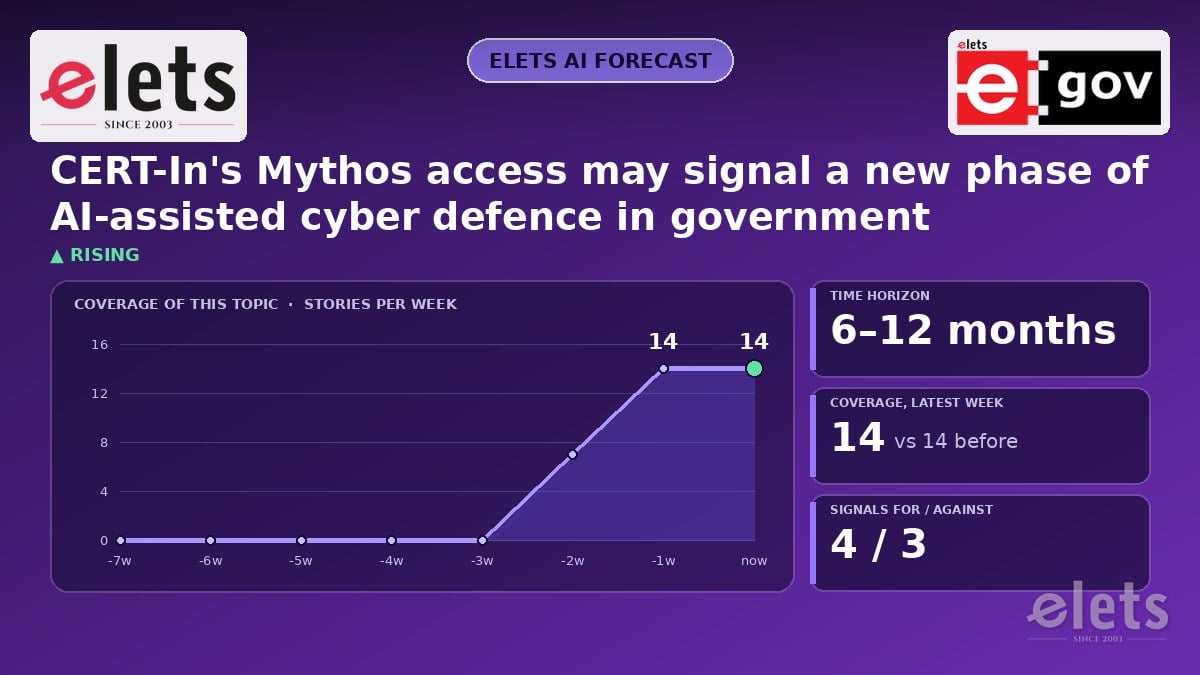
India's cyber agency now has access to a frontier AI model, and similar arrangements could follow elsewhere as warnings about AI-enabled attacks grow.

Assessment: Plausible · Horizon: 6–12 months · Direction: rising

Uncertainty: Wider adoption will depend on vendor willingness to share frontier models with governments, on security and vetting norms, and on how cautiously agencies like CERT-In assess early use. Measured or restricted rollouts could keep this confined to a few agencies.

Verified development
When: 3 November 2026

CERT-In, India's national cybersecurity agency, has secured access to Anthropic's Mythos AI model for cybersecurity testing. A MeitY official said AI firms had taken months to detect agents operating in Indian systems. The agency is reported to be assessing the model's use in a measured manner.
Interpretation
AI's reading of the signals is that CERT-In's access could become a reference case. Other national cyber bodies may seek similar arrangements, given official warnings about AI-enabled threats to critical infrastructure and moves towards more centralised cyber defence.
Within India, the evidence suggests that early CERT-In findings may shape how frontier models are used in defensive testing across government. That influence may be tempered by MeitY's emerging framework on model vetting and approval norms.
Who it matters to
- CERT-In and state cyber cells: frontier models may change how vulnerabilities are found and tested.
- Critical-infrastructure operators: AI-assisted testing could raise expectations on their security posture.
- AI and cybersecurity vendors: government access deals may become a new channel for public-sector engagement.
- Policy teams at MeitY: model access raises questions on vetting, data handling and accountability.
Supporting signals
- CERT-In has already secured access to a frontier AI model for cybersecurity testing.
- A MeitY official said AI firms took months to detect agents in Indian systems, which underlines the case for faster detection tools.
- Official warnings about AI cyberattacks on critical infrastructure add pressure on agencies to adopt AI defensively.
- Governments are restructuring cyber defence, for example South Korea's proposed cross-government command and the UK's resilience legislation.
Contrary evidence and risks
- CERT-In says it will assess the model's use in a measured manner, which may slow wider rollout.
- MeitY's proposed AI training framework includes model vetting and has raised questions over approval norms, which could add friction.
- Market anxiety over possible US AI regulation could affect how freely US AI firms share frontier models.
The global picture
A UK official has warned that the UK will face AI cyberattacks on critical infrastructure by 2028. The UK government has also published factsheets on its Cyber Security and Resilience Bill and launched a Software Security Ambassadors Scheme.
South Korea is weighing a cross-government cybersecurity command. In the US, CISA has appointed a former HHS official to lead its infrastructure security division.
Next milestone to watch
- Any CERT-In statement on initial findings from Mythos testing
- Similar frontier-model access announcements by other national cyber agencies
- MeitY's final position on model vetting and approval norms
- Progress of the UK Cyber Security and Resilience Bill
Editorial note
AI assisted the research and drafting of this forecast; the Elets Editorial Desk reviewed it and owns the published assessment. Reviewed: 04 Nov 2026. It gives a qualitative assessment, not a probability. Spotted an error or have an update? Write to the Elets Editorial Desk and we will correct it and note the change here.
This is what AI says. It is an AI-assisted reading of publicly reported developments, reviewed by the Elets Editorial Desk. It is a qualitative assessment with stated uncertainty, not a probability or a prediction of certainty, and not investment, legal or policy advice. Outcomes may differ.