



India’s Finance Minister P. Chidambaram increased the health allocation in the latest budget by 15% compared to the last fiscal year to INR 165.34 billion with particular stress on HIV/AIDS, polio and health care for the rural and urban poor. He has also promised new interventions such as an insurance plan of up to INR 30,000 for the unorganised workforce and a special facility for geriatric care.

Expressing satisfaction that the prevalence of HIV/AIDS in the country had come down to 0.36% from 0.9%, Chidambaram allotted INR 9.93 billion (INR 993 crore) for the National AIDS Control Organisation (NACO), the apex body set up to prevent, curb and educate people about the disease.

Chidambaram also proposed to exempt the expensive anti-AIDS drug Atazanavir and its bulk drug from excise duty and cut customs duty from 10 to 5 percent, on lifesaving drugs. Reduction in customs duty on project imports and life-saving drugs and excise duty concessions for the pharma sector are also welcome relief.

The finance minister has made an outlay of INR 10.42 billion (INR 1,042 crore) for a revised strategy on polio across the country and especially Bihar and Uttar Pradesh.

For the aged poor, the center has promised geriatric medical care in a tertiary hospital in each state apart from setting up two institutes of geriatrics for which a total of INR 400 crore has been allocated.
On the delivery side, the government is upgrading 323 district hospitals and is planning to set up community-owned, 24X7 decentralised health centres under the National Rural Health Mission. Nearly 4.62 lakh social health activists have been trained to activate this plan. Praising the health ministry’s flagship programme – the National Rural Health Mission (NRHM) that aims at improving the health care of the rural population, Chidambaram allocated INR 120.5 billion for the project.
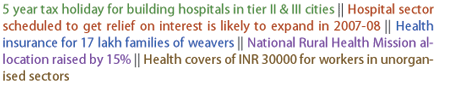
By providing tax holiday for hospitals in semi-urban and rural areas and with the active promotion of health insurance, the budget seeks to ensure increased availability and financial access to quality health care for the common man. The FM announced income tax exemption for the premium paid for health insurance of parents and the introduction of Rashtriya Swasthya Bima Yojana (National Health Insurance Scheme,) which, it is hoped will pave way for universal health insurance in the country. The health insurance plan is expected to offer cover of INR 30,000 for every worker in the unorganised sector under the BPL category. The plan, for which the Centre’s share of premia will be INR 205 crore, is being rolled out in Delhi, Haryana and Rajasthan to begin with.
Corporate health care is now expected to witness heightened activity with a new sub-section (11C) in Section 80-IB that will grant a 5 year tax holiday to hospitals set up anywhere in the country, except specified urban agglomerations. This window will be open between April 2008 and March 2013 during which the hospital has to begin operations. Corporate hospitals may now take a re-look at their growth strategies and deploy investments in these regions. High-tech health care facilities in rural India will reduce the need for patients to travel to urban centres for primary referrals. Given the need for 1 lakh beds in the next two decades, these incentives will help bridge the gap.
The move may also trigger expansions by neighbourhood clinics and nursing homes. Health care trackers see growth in the number of 50-100 bed hospitals, which will offer speciality treatment in a few areas like cardiac or trauma care. The proposed weighted reduction of 125% on outsourced R&D expenditure will encourage higher spending by R&D focused companies towards new chemical entity (NCE) and novel drug delivery systems (NDDS) related R&D activities.
Reservations
There have of course been reservations about the the budget’s outlay on health being only 15% higher than last year. A steady annual increase of 35% is needed over several years to raise public health-spending from the present paltry 0.9% of GDP to the National Common Minimum Plans target of 2 to 3%. Another requirement is greater decentralisation of the public health delivery system. Health infrastructure is marked by great disparity between rural and urban areas. Most secondary and tertiary health facilities are available in urban and tier-II cities. There is a need to incentivise building up health infrastructure in rural areas.
An important component of the National Rural Health Mission has seen its allocation decline by over 30%. Although the government promises to accelerate the Tobacco Control Programme, its outlay has been cut by 7%. And just as polio is spreading, support for polio eradication has been slashed. Monitoring and evaluation mechanisms need to be strengthened significantly.
Many are complaining that this years budget increase of 15% is significantly less than the increase implemented in the previous year to the effect of 24%. Currently, the government spends less than 1 percent of the Gross Domestic Product (GDP) on health and this increased allocation, is being considered insignificant by many.
Still,the controls on drug prices, which has been a source of major concern within the industry, is a step in the right direction. The Contract Research Organisations (CROs) would be particularly benefited. As Mr. Chidambaram said,”I think we do not pay enough attention to outcomes as we do to outlays; or to physical targets as we do to financial targets; or to quality as we do to quantity.”