




“e-Procurement platform has decisively demonstrated benefits in cost savings due to improved competition, improved internal efficiency – the tender cycle period came down from 120 days to less than 35 days, brought in transparency in tender process, reduced bidding cost for contractors and reduction in physical interface between government staff and contractor,” says Suresh Chanda, IT Secretary, Government of Andhra Pradesh
Andhra Pradesh (AP) is the first state to implement electronic procurement. What has been the achievements and impact of this project?

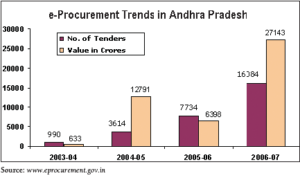
AP state was the first state in India to harness the potential of IT in bringing transparency in tender system for procurement of goods, contract and civil works. e-Procurement pilot was launched in the year 2003-04 with 564 transactions taking place in that year with total transaction value of 1982 Crores. Now more than 20 departments, 30 public sector units, 110 municipalities and 10 universities are using this platform for procurement. During 2007-08 10,054 tenders were finalised with transaction value of INR 1,6 9,570 million. From its inception till May 2008, more than 30,800 tenders have been handled by the procurement system with a total transaction value of more than INR 6,70,000 million.

e-Procurement platform has decisively demonstrated benefits in cost savings due to improved competition, improved internal efficiency– the tender cycle period came down from 120 days to less than 35 days, brought in transparency in tender process, reduced bidding cost for contractors and reduction in physical interface between government staff and contractor. It has reduced the previous system of three visits of a contractor to the concerned government offi ce – fi rst to obtain tender document, second visit to fi le tender and third related tender opening.

What are the services offered through the e-Procurement. gov.in platform, the e-Procurement portal of AP government?

The services being offered through the e-Procurement.gov.in platform are indent creation by government departments, tender publication, digitally signed bid submission, forward and reverse auction.
“Some of the implementation challenges in e-Procurement project implementation are: convincing the departments about the benefi ts of e-Procurement; IT infrastructure like PCs and Internet connectivity at remote locations; inter- departmental coordination; non-standard processes – different procurement process in different departments; resistance to change; security and authentication; creating trust in e-Procurement system; convincing bidders that e-Procurement is safe and secure; and training contractors/bidders who were spread all over the state”
What were the major drawbacks of the manual system of procurement? What were some of the implementation challenges faced while implementing e-Procurement?
The major drawback in the manual system are: possible discrimination in issue of tender document; possible physical threats to bidders during fi lling of bids; cartel formation – suppressed competition; pressures on department offi cials; inordinate delays in tender fi nalisation; high degree of physical interface with the government staff for obtaining tender document, clarifi cation, submission of bids and tender opening etc.; inadequate transparency and the the lack of management information system (MIS) reports on past procurements.
Some of the implementation challenges in e-Procurement project implementation are: convincing the departments about the benefi ts of e-Procurement; IT infrastructure like PCs and Internet connectivity at remote locations; interdepartmental coordination; non-standard processes – different procurement process in different departments; resistance to change; security and authentication; creating trust in e-Procurement system; convincing bidders that e-Procurement is safe and secure; and training contractors/bidders who were spread all over the state.
Which are the departments that are following electronic mode of procurement for its purchase in your state? What has been the cost of implementation?
The major departments implementing e-Procurement in AP are: Irrigation, Panchayat Raj, Rural Water Supply Department, Public Health Engineering, Hyderabad Metro Water Supply Board, Urban Development Authorities, Electricity Department, Singareni Collieries Company Ltd. e-Procurement system is developed on the public-private partnership (PPP) model. The entire capital cost, operations and management cost is the responsibility of the service provider. Service provider gets the transaction charge from the bidder for each transaction. Presently the transaction charge is 0.03% of the estimated cost with a ceiling of INR 10,000 for tender up to INR 500 million and a maximum of INR 25,000/- for tenders above INR 500 million.
What has been the experience so far in terms of the benefi ts achieved in bringing about transparency and effi ciency in the procurement process?
e-Procurement platform has decisively demonstrated benefi ts in cost-savings due to improved competition, improved internal effi ciency – the tender cycle period came down from 120 days to less than 35 days, brought in transparency in tender process, reduced bidding cost for contractors and reduction in physical interface between government staff and contractor.
What are the change management issues that had to be dealt with in the transition from manual to electronic procurement?
 Implementation of e-Procurement was not merely implementing off-the-shelf software. It involved change in perceptions, attitudes and processes. First of all, it involved convincing all stake holders that it is safe and secure to use e-Procurement. Creating IT awareness among bidders was another challenge. Reliable Internet connectivity in remote offi ce locations and similar facility for bidders to participate in e-Procurement platform was another challenge. Constitution of high level coordination committees, training, workshops and help-desk modes were used to meet change management issues.
How is the security of information being maintained? Bids fi led by bidder are digitally signed to protect information security.
What are your plans for the e-Procurement project in the coming years?
We plan to have integration of enterprise resource planning (ERP) system of few user departments with e-Procurement Platform and linking of contractor database for facilitating evaluation of tenders.