


AI Forecast · eGov

This is what AI says. It is an AI-assisted reading of publicly reported developments, reviewed by the Elets Editorial Desk. It is a qualitative assessment with stated uncertainty, not a probability or a prediction of certainty, and not investment, legal or policy advice. Outcomes may differ.
From Singapore's AntiScam Pango app to TRAI's online DND services, the signals point to more state-built tools to help citizens spot fraud.

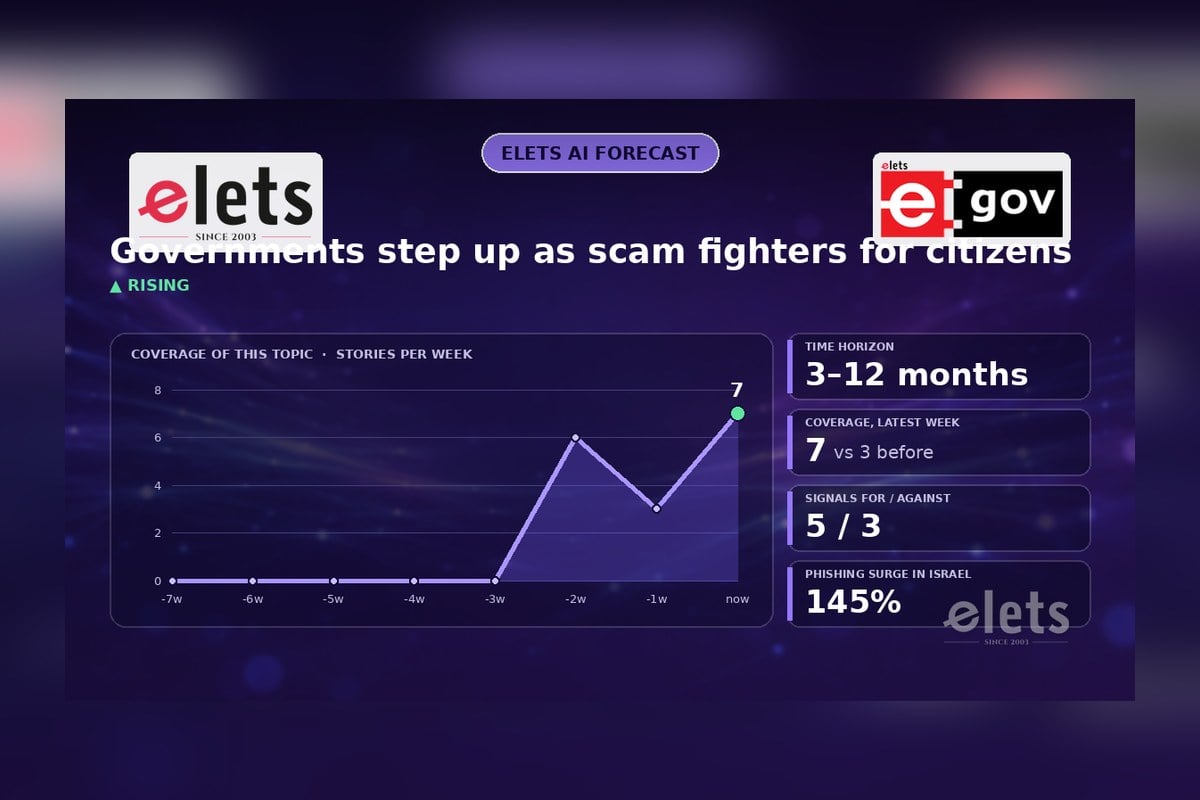
Assessment: Gaining momentum · Horizon: 3–12 months · Direction: rising

Uncertainty: Uptake depends on public trust, privacy safeguards and how well tools keep pace with AI-enabled fraud. Governments may instead lean on platform liability and bank-side controls rather than building citizen apps.

Verified development
When: 4 November 2026

Singapore's GovTech released a new AntiScam Pango app that analyses notifications to flag suspicious conversations.
Interpretation
AI's reading is that governments are moving towards direct, citizen-facing fraud defences. Israel has launched a national cyber portal amid a reported 145% surge in phishing, and TRAI's new Network Anubhav platform includes online DND services alongside its anti-spam work.
In India, CERT-In's warnings to banks, NBFCs and fintechs about fraud and attacks executed through AI agents suggest scams are becoming more automated. That could push more states and regulators towards public-facing reporting and detection tools, supported by investment in dedicated cyber crime policing, such as new cyber crime police stations in Odisha.
Who it matters to
- State police and cyber crime cells building reporting and response channels
- Banks, NBFCs and fintechs facing AI-agent-driven fraud
- Telecom regulators and operators handling spam and DND services
- GovTech and app developers designing privacy-preserving scam detection
Supporting signals
- Singapore GovTech launched AntiScam Pango to flag suspicious conversations from notifications.
- Israel launched a national cyber portal amid a 145% surge in phishing.
- CERT-In warned banks and fintechs of fraud through AI agents.
- TRAI's new platform includes online DND services as part of anti-spam efforts.
- Odisha is building dedicated Cyber Crime and Economic Offence police stations.
Contrary evidence and risks
- Apps that read notifications raise privacy questions, and reports note gaps in remedies for data breach victims under the DPDP Act.
- India is also considering scrapping legal immunity for social media platforms, a route that could shift the burden to platforms rather than citizen tools.
- AI systems themselves can be used offensively, as a security test in which Gemini AI breached three firms showed, which may complicate AI-based defences.
Why it matters for India
CERT-In has flagged AI-agent-driven fraud risks to the financial sector, and I4C has described how hackers are carrying out such attacks. This raises the case for citizen-level detection tools alongside institutional defences.
TRAI's Network Anubhav platform already offers online DND services, and its Chairman has described continuing work to curb spam. Together these form an existing channel that could be extended.
Next milestone to watch
- Adoption figures or expansion of Singapore's AntiScam Pango app
- Any Indian state or regulator announcing a citizen anti-scam app or portal
- Further CERT-In or I4C advisories on AI-agent fraud
- Decisions on social media platform liability in India
Editorial note
AI assisted the research and drafting of this forecast; the Elets Editorial Desk reviewed it and owns the published assessment. Reviewed: 05 Nov 2026. It gives a qualitative assessment, not a probability. Spotted an error or have an update? Write to the Elets Editorial Desk and we will correct it and note the change here.
This is what AI says. It is an AI-assisted reading of publicly reported developments, reviewed by the Elets Editorial Desk. It is a qualitative assessment with stated uncertainty, not a probability or a prediction of certainty, and not investment, legal or policy advice. Outcomes may differ.