


AI Forecast · eGov

This is what AI says. It is an AI-assisted reading of publicly reported developments, reviewed by the Elets Editorial Desk. It is a qualitative assessment with stated uncertainty, not a probability or a prediction of certainty, and not investment, legal or policy advice. Outcomes may differ.
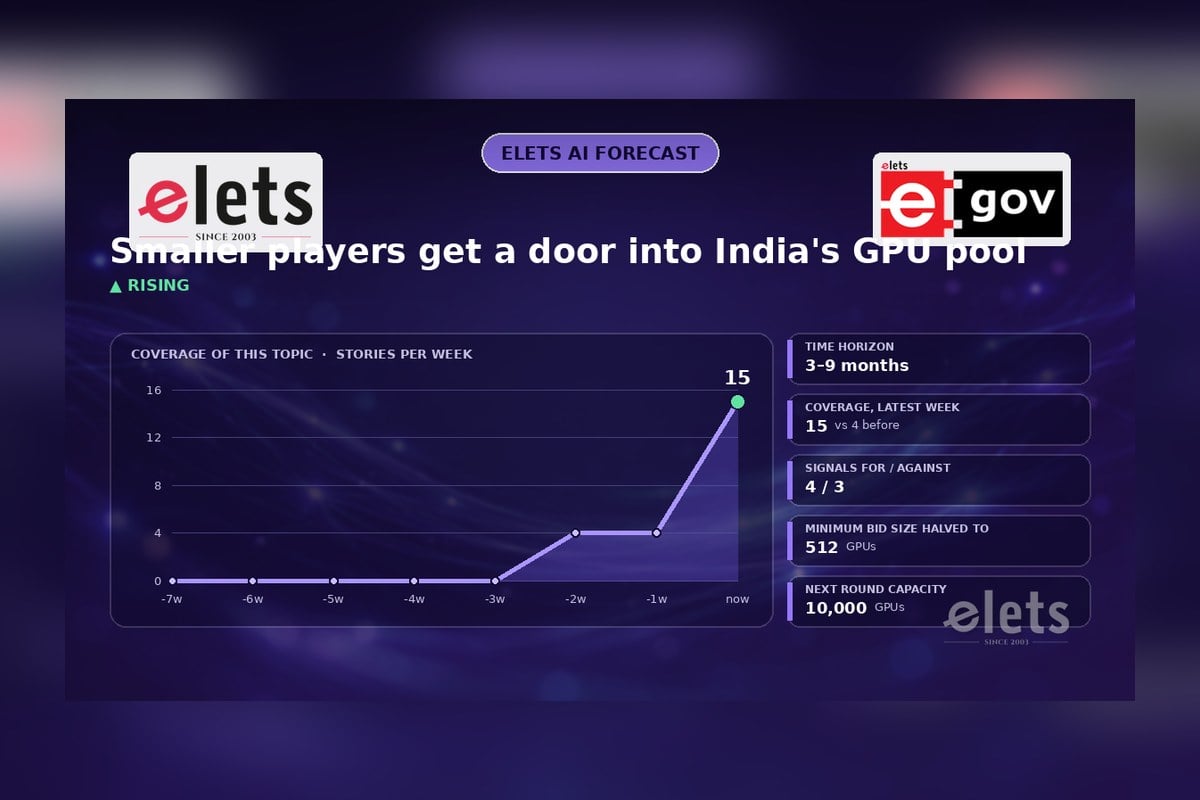
By halving the minimum bid size to 512 GPUs, IndiaAI may draw a wider set of compute providers into its next 10,000-GPU round.

Assessment: Plausible · Horizon: 3–9 months · Direction: rising

Uncertainty: The outcome depends on how many smaller operators can meet the remaining technical and commercial terms, and on hardware supply and investor appetite. Volatile chip markets and possible project delays could limit new entrants.

Verified development
When: 5 November 2026

IndiaAI has halved the minimum capacity requirement to 512 GPU units for its 10,000-GPU compute round, lowering the entry bar for providers seeking to supply capacity under the mission.
Interpretation
AI's reading is that a lower threshold could bring smaller data centre and cloud operators into the round, potentially spreading subsidised compute across more providers. Demand for that compute may grow as IndiaAI releases more indigenous foundation models, such as EKA-1 and the Dhīr 2B and 5B models, along with models designed to run offline.
The evidence also suggests that compute planning is moving to the states. NITI Aayog's Frontier Tech Hub has issued a data centre evaluation framework to help states plan, and public bodies such as a West Bengal power utility are already tendering GPUs for AI application development.
Who it matters to
- Mid-sized data centre and GPU cloud operators that could now qualify for IndiaAI rounds
- State IT departments planning data centre capacity under NITI Aayog's framework
- AI start-ups and model builders that depend on subsidised compute access
Supporting signals
- The minimum capacity requirement has been halved to 512 units for the 10,000-GPU round.
- New indigenous foundation models released under IndiaAI may add to demand for training and inference compute.
- NITI Aayog's data centre evaluation framework is intended to help states plan for sustainable growth.
- Public-sector GPU procurement is appearing in state tenders.
Contrary evidence and risks
- Chip and AI infrastructure stocks fell sharply after the US midterms amid AI regulation fears, which could tighten capital for capacity build-outs.
- Construction delays have been cited as a concern for AI infrastructure firms, a sign that physical capacity can lag plans.
- India's AI regulation consultation paper is reportedly nearing completion and could add compliance considerations for providers.
What the signals show
Within a few days, IndiaAI cut its capacity threshold, released three indigenous models, and NITI Aayog published a framework for state data centre planning. Together these point to a supply-and-demand push on domestic compute.
GPU procurement is also showing up outside the central mission, in a state power utility's tender to upgrade servers for AI work.
Next milestone to watch
- Bid submissions and the empanelment list for the 10,000-GPU round
- States adopting NITI Aayog's data centre evaluation framework
- Further GPU tenders from state agencies and PSUs
- Release of India's AI regulation consultation paper
Editorial note
AI assisted the research and drafting of this forecast; the Elets Editorial Desk reviewed it and owns the published assessment. Reviewed: 05 Nov 2026. It gives a qualitative assessment, not a probability. Spotted an error or have an update? Write to the Elets Editorial Desk and we will correct it and note the change here.
This is what AI says. It is an AI-assisted reading of publicly reported developments, reviewed by the Elets Editorial Desk. It is a qualitative assessment with stated uncertainty, not a probability or a prediction of certainty, and not investment, legal or policy advice. Outcomes may differ.