
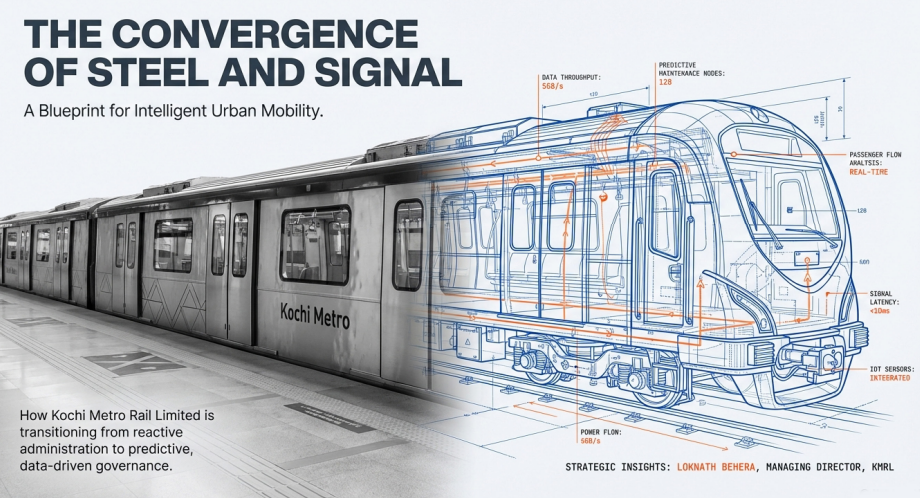
Artificial Intelligence is poised to transform urban mobility governance in India by empowering transport authorities to transition from reactive administration to predictive, data-driven decision-making. As metro systems expand across Indian cities, AI offers the capability to integrate data from ticketing systems, passenger information networks, CCTV, traffic sensors, and mobile applications to optimise operations in real time.

In this conversation, Loknath Behera, Managing Director, Kochi Metro Rail Limited, outlines to Muskan Jaiswal how AI can strengthen predictive maintenance, energy optimisation, multimodal coordination, and passenger-centric services, positioning metro systems like Kochi Metro Rail Limited as intelligent, climate-responsive, and future-ready transport networks aligned with India’s broader smart mobility vision.
How can Artificial Intelligence transform urban mobility governance and public transport systems in India over the next five years?
Over the next five years, Artificial Intelligence is expected to play a central role in transforming urban mobility governance and public transport systems in India. AI will enable transport authorities to move from reactive management to predictive and data-driven decision-making. By integrating data from ticketing systems, passenger information systems, traffic sensors, CCTV networks, and mobile applications, AI platforms can provide real-time insights into travel demand, congestion patterns, and service performance.

For metro systems, this means better timetable planning, dynamic frequency adjustment, improved crowd management, and more responsive customer service. At the governance level, AI can support evidence-based policy formulation, optimise subsidy allocation, and enhance coordination among multiple transportation modes. Ultimately, AI will help cities deliver more reliable, inclusive, and efficient mobility services while ensuring transparency and accountability in operations.
What role can AI play in predictive maintenance, energy optimisation, and asset lifecycle management in metro rail systems?
AI has significant potential in enhancing the operational efficiency and financial sustainability of metro rail systems through predictive maintenance, energy optimisation, and asset lifecycle management. By analyzing data from sensors installed on rolling stock, tracks, signaling systems, and electrical equipment, AI models can predict failures before they occur. This reduces unplanned downtime, enhances safety, and lowers maintenance costs. Predictive maintenance also helps in optimizing spare parts inventory and workforce deployment.
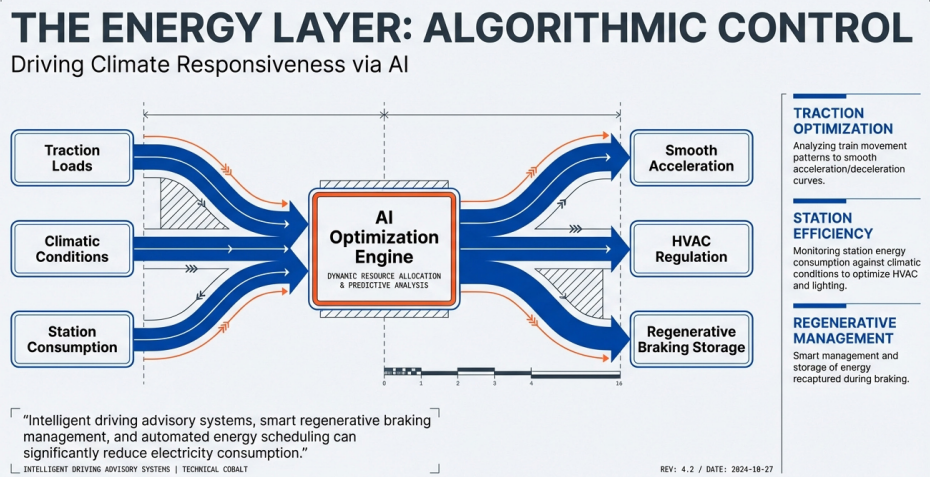
In energy management, AI can analyze train movement patterns, traction loads, station energy consumption, and climatic conditions to optimize power usage. Intelligent driving advisory systems, smart regenerative braking management, and automated energy scheduling can significantly reduce electricity consumption.
Also Read | AI for Scalable and Inclusive Governance The Odisha Model
For asset lifecycle management, AI enables data-driven planning for rehabilitation, replacement, and upgrades. This ensures better utilization of capital investments and extends the useful life of critical infrastructure.
What are the flagship AI or data-driven initiatives currently being implemented by Kochi Metro Rail Limited?
Globally, the most successful ecosystems are not built by Kochi Metro Rail Ltd has been steadily strengthening its digital and data-driven ecosystem. One flagship initiative is the integration of passenger data analytics with fare collection, mobile applications, and station- level monitoring systems to improve service planning and customer experience.
By analyzing ridership patterns, peak-hour demand, event- based travel surges, and station-wise footfall, KMRL is developing intelligent dashboards that support operational decisions such as train frequency adjustment, staff deployment, and targeted marketing of travel passes.
KMRL also envisions the use of AI-enabled QR-based ticketing linked with events and commercial activities, enabling seamless travel for passengers attending large public programs. This model has strong potential for replication in other urban transport systems, especially in tourism- and event- driven cities.
How can cities like Kochi contribute to India’s broader AI and smart mobility vision?
Cities like Kochi play a critical role in shaping India’s AI-driven smart mobility ecosystem. As a medium-sized, environmentally sensitive coastal city, Kochi provides an ideal testbed for sustainable and climate- responsive transport solutions.
By integrating metro, water metro, feeder buses, non-motorized transport, and shared mobility through data platforms, Kochi can demonstrate how AI can support multimodal coordination and first-mile–last-mile connectivity. AI-based demand forecasting and route optimization can help reduce private vehicle dependency and carbon emissions. KMRL’s emphasis on renewable energy, electric mobility, and green infrastructure, combined with intelligent monitoring systems, aligns closely with India’s climate commitments and smart city objectives.
What role do public– private partnerships, startups, and academic institutions play in accelerating AI adoption in urban mobility??
Public–private partnerships, startups, and academic institutions are essential for accelerating AI adoption in urban mobility. Government agencies provide domain knowledge, datasets, and regulatory support, while private sector partners bring technological expertise and innovation capacity.Startups can develop customized solutions in areas such as passenger analytics, predictive maintenance, and mobility-as-a-service platforms. Academic institutions can support research, validation, and skill development in AI and transport engineering.
KMRL actively encourages collaboration with technology firms, fintech partners, research institutions, and incubators to pilot innovative solutions in real operational environments.
What additional measures are needed to build a robust AI ecosystem for urban mobility in Kerala and across India?
To develop a strong AI ecosystem for urban mobility in Kerala and across India, the following measures are recommended:
• Creation of standardized and interoperable transport data platforms
• Strong data governance and cybersecurity frameworks
• Capacity building and training of transport professionals in data science and AI
• Dedicated innovation funds for pilot projects
• Regulatory sandboxes for testing new mobility technologies
• Promotion of open data for research and innovation
Also Read | AI Can Expand Healthcare Capacity and Improve Early Disease Detection”
Additionally, sustained leadership commitment and inter-agency coordination are critical for mainstreaming AI in public transport governance. Artificial Intelligence represents a strategic opportunity to reimagine urban mobility in India. For Kochi Metro, AI is not merely a technological upgrade but a tool to enhance operational efficiency, environmental sustainability, and passenger trust. By combining responsible data governance, collaborative innovation, and citizen-centric design, metro systems can evolve into intelligent, resilient, and future-ready transport networks. Kochi’s experience demonstrates how Indian cities can harness AI to build inclusive, climate- responsive, and globally competitive mobility systems.