



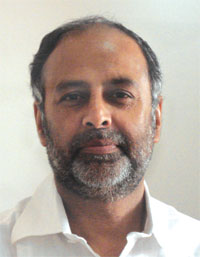
 DR sudhir krishna
Additional Secretary Ministry of Panchayati Raj
For this Karnataka cadre 1977-batch IAS officer with diverse experience, e-Literacy of the Panchayat members is a key focus area. Speaking to Prachi Shirur and Gayatri Maheshwary of e-Gov, Dr Sudhir Krishna informs on how ICT is being used to bring in transparency and efficiency in the working of the Pachayats.

Lack of regular supply of electricity in the villages is another major challenge in the implementation of e-Panchayat programme.

Tell us about the overall scenario of Panchayats in the country.

The Panchayats fall in the third tier and are constitutionally mandated to do 29 functions of the public services which include amongst others, agriculture, rural development, irrigation, soil and water management, health care, rural housing and rural connectivity.

The involvement of the Panchayats in the various states, at the moment, is very gradual but is very significant at the same time. There are 2.5 lakh Panchayat members in 626 districts of the country. The Panchayat in all the states have three level. Gram Panchayat, which is at the lowest level, above it is the Intermediate Panchayat and at the District Level is the District Panchayat. This is an exception in the north eastern states- Meghalaya, Mizoram and Nagaland which have District Councils. The Panchayats across the country get funds to run the schemes in the rural areas.
How successful have the Panchayats been in delivering services to the citizens through IT?
The Panchayats need a good Management Information System (MIS) to perform effectively and efficiently, which has to be open ended so that the citizens are aware of what is happening and also they are able to communicate with the Panchayats for their grievances.
With the help of a good MIS, the senior officials of the government, both at the state and the central level, will also be kept up-to-date on the assignments and the functions of the Panchayats in the country. This will bring in transparency and the government will have a clear picture on what the Panchayats are doing in their respective states.
The e-Panchayat programme is the solution for a two way clear and a transparent communication between the top level and local level and also between the citizens and the Panchayats. With Panchayats coming online, it has become an important source for the huge flow of data and information for the governments at all the levels. The e-Panchayat programme is expected to provide connectivity in the rural areas in any mode which can be through Internet, broad band or telephone.
At the moment the centre is focusing on the computer literacy of the 3 million Panchayat members in the country for which they are seeking collaboration with the various service providers.
What are the challenges faced in implementing e-Panchayat programme?
There are approximately 2.5 lakh Panchayat members in the country spread across 28 states and seven Union Territories. The physical connectivity of the Panchayats in the remote areas is an issue and providing Internet connectivity in such areas is a massive task.
Another major challenge is that Panchayats are not uniform in terms of the number of the people they cater to in an area.
The functions of Panchayats also vary from state to state. In some states, a lot of work has been done, while in some other states, things are still at the nascent stage. This variation across the states is due to the fact that it is the state government which decides what functions the Panchayats will perform depending upon the state’s requirements.
Lack of regular supply of electricity in the villages is another major challenge in the implementation of e-Panchayat programme. The electricity connection and then its regular supply has to be ensured for the efficient delivery of the services to the citizens.
Economic level of the Panchayats is another limitation which also varies from state to state. The prosperous states have a good infrastructure and in the poor and remote villages, infrastructure is not very good and it is a major task for the Panchayats to organise themselves and deliver the services.
The poor economic level in remote areas not only reflects on the infrastructure but also on the manpower as in such areas people are not so conversant with the Operations and the Management activity.
Re-engineering of the whole process is also a major task. Also, the existing data has to be digitised. This is very challenging as all the different states have their own ways of doing things, though a standardised procurement model has been prepared for the states.
Tell us about the progress made so far in e-Panchayat programme implementation.
The Ministry has taken one year to prepare the detailed project report (DPR) of all the states. These state specific reports are in four phases, namely:
-
Inception
-
Information and Service Need Assessment
-
Business Process Re-engineering
-
Detailed Project Report
The computerisation of Panchayats has already been done in Gujarat and Andhra Pradesh. The computerisation depends upon the use of the technology, but the reduction in cost is the major aim. The DPRs of the state cannot be uniformly reformed; it depends upon state to state preparedness as well of the infrastructure of the area. To manage the data of the state, the government is open to cloud computing as well.
The connectivity to the Panchayats is being provided through the ISPs which is more reliable and less costly as compared to. VSAT technology
How is the funding for the e-Panchayat programme done?
As against a centralised fund for e-Panchayats, which had been practiced earlier, now the state governments have been given funds for implementing the rural development schemes undertaken in their states at the grass rool level.
The cost is monetised in three years and depending upon the scheme the payment is made monthly or quarterly.
The unit cost of a Panchayat is INR 0.3 million in three years which includes the hardware, software, maintenance and the, staff cost and everything in the scheme is to be provided by the service provider.
How do you look at the convergence of e-Panchayats with the Common Service Centres (CSC’s)?
The e-Panchayat programme is open to converge with the CSCs in their programme. The CSCs can be housed in the Panchayat building which already has been done in many states. It is an option given to the states to converge with the CSC’s, but it is not enforced on them.