


India is a rapidly urbanising nation that is expected to have around 814 million urban dwellers in its cities by 2050. This will increase the demand for affordable housing, civic amenities and services. To address this and imbibe sustainability and liveability in urban development, the Government of India has rolled out various schemes and programmes, writes Adarsh Som of Elets News Network (ENN). Here’s how India is heading towards achieving SDG 11.1: Access to adequate, safe and affordable housing for all

In September 2015, the United Nations General Assembly gave out a set of 17 Sustainable Development Goals (SDGs) to be fulfilled by 2030. These 17 goals focus on various aspects such as reducing poverty, increasing food supplies and production, housing, safe water and sanitation, higher quality of education, and a greener environment that if improved can lead to a sustainable, liveable and resilient future. The SDG 11 specifically emphasises on making cities sustainable and inclusive. This refers to providing basic urban services to all and aiming for an inclusive urban society. Also, it considers investment in public transport, creating green public spaces, and improving urban planning and management in a comprehensive way.
Roadblocks in Achieving SDG 11.1 in India
SDG 11 consists of 10 sub-goals. This special issue of the magazine focuses on SDG 11.1: to ensure access to adequate, safe and affordable housing and basic services, including the upgradation of slums for all by 2030. In the first five years of the launch of SDGs, India faced various difficulties such as effective implementation of the goals. The largest roadblock is the COVID-19 pandemic. Owing to the pandemic, the focus has been completely shifted to enhance medical facilities and upscale the healthcare sector as saving lives is of primary importance.

However, considering the fact that preventive measures like social distancing, cleanliness, and safe and adequate water and sanitation facilities are needed to stay safe amidst the pandemic, these are not possible in many urban areas. According to the previous census of 2011, as many as 66 million Indians were found to be residing in slums i.e. over 17 per cent of the country’s urban population. The National Family Health Survey 2015-16 (NFHS-4) stated that 42 per cent households in Indian cities have no room for social distancing as three or more people share a room in these households. These numbers have only grown with time. Congestion makes the rate of spread of the infection faster and in such slums social distancing or home isolation or quarantine are mere terms and unachievable in reality.

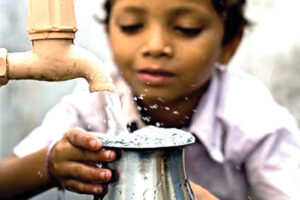
Looking at the SDG 11.1: to ensure access to adequate, safe and affordable housing and basic services, including the upgradation of slumsit, is seen that in slums and other informal settlements the access to clean water is sub-optimal. Many households in India, especially in the remote areas and in slums on the periphery of cities have to fetch water from a common source located somewhere out. Therefore, such households have no access to safe, clean and adequate drinking water within the house premises. Moreover, the responsibility of fetching water for daily chores is majorly on the shoulders of the women. The exposure, especially in the time of the pandemic, makes them susceptible to infection and make their children and other family members vulnerable as well.

As per the NFHS-4 data, every second and fourth household belonging to the lowest and second-lowest wealth quintile did not have access to soap and water, while every fifth urban household in India lacked proper hand-hygiene practice. The message of regular hand washing, keeping hygiene and cleanliness is being propagated by the government but the ones have no access to in-house water taps, how would they manage to keep clean and maintain social distancing. The report also mentions that nearly 15 per cent of the urban households use shared toilets and this enhances the risk of infection.

The situation is grave as besides these challenges. The loss of jobs and lack of income owing to the lockdowns, make it difficult for the poor to survive. The situation is evident enough to realise the significance of resilient cities, and the SDG 11.1 to at least ensure that people have access to safe and adequate basic services like water and sanitation and a shelter to stay safe indoors.
India’s Take on SDGs & SDG 11.1
The country that houses the world’s 17 per cent population plays a crucial role in achieving the targets globally. Since the launch of SDGs, India has been proactively working to achieve the goals. Considering the sheer population size and diversity in geography, demography and inequalities in the society, the roadblocks are huge. Despite this, India became the first country in the world to roll out SDG India Index 2018. In 2019 the Index was revised and made more refined and comprehensive as compared to the previous one. The Index played an instrumental role in mobilising the states and union territories to actively work towards achieving SDGs. It helped in spreading awareness on SDGs within the government, media, researchers, and civil societies. Some of the states have initiated district-level ranking to show effective implementation of the SDGs.
The PM Narendra Modi-led Government of India has figured out that by inducing a competitive spirit among the states and UTs best results can be achieved. From Swachh Bharat Abhiyan to Make in India, from Smart Cities Mission to SDGs, from Affordable Housing to Green Energy and more, creating competition among the stakeholders have fetched fast-paced and qualitative development.
For achieving SDG 11.1, the governments have identified three major areas –
- Reforms in the real estate sector – Steps have been taken to establish a Real Estate Regulator in each of the states that attempts to better serve the home buyers’ interests.
- Urban Transformation and Housing for All – Under this, a massive program named Pradhan Mantri Awas Yojana (PMAY) was launched by the Centre to provide houses to all homeless persons by the year 2022 covering 4318 cities and towns. In 500 cities, basic civic amenities like clean water and sanitation are being provided under another central program named Atal Mission for Rejuvenation and Urban Transformation (AMRUT).
- Sustainable urbanisation – In this regard, the Centre had launched Smart Cities Mission in 2015 that aims at building sustainable and inclusive cities. The mission focuses on improving cities through retrofitting, redevelopment, greenfield development, and implementing various smart facilities like smart water, smart energy, and more. The Centre has shortlisted 100 cities to turn into smart cities.
Looking at how India aims to achieve the SDG 11, there are a few national level indicators that have been identified in this regard. The Centre has launched schemes to provide affordable housing to all. According to the data on the official website of the Ministry of Housing and Urban Affairs (MoHUA), as of April 28, 2021, 112.52 lakh houses have been sanctioned. Moreover, 80.2 lakh houses have been grounded and 48.02 lakh houses have been completed. The Ministry has rolled out four initiatives – Pradhan Mantri Awas Yojana (PMAY) to provide housing for all, Affordable Rental Housing Complexes (ARHCs), Global Housing Technology Challenge (GHTC), and CLSS Awas Portal.
Concrete steps have also been undertaken to provide safe sanitation facilities and door to door waste collection under the Swachh Bharat Mission (SBM). As per the MoHUA data on the official website of SBM, nearly 62.5 lakh individual toilets have been constructed while just above 6 lakh community toilets have been constructed. This has already surpassed the mission target. Another interesting thing to note is that there are 83,528 wards that have achieved 100 per cent door to door collection under the SBM. The Ministry has also undertaken steps to improve the capacity in the sewage treatment plants and improve waste water treatment.

The Wrap Up
As the urban vulnerabilities are getting amplified during the COVID era, the government and the civic authorities need to revisit the idea of making cities sustainable as envisaged in SDG 11 and take effective steps towards the implementation. COVID is a major challenge but it is not the only one, such pandemics can occur in future again, hence, our preparedness needs enhancement.