




The ideal scenario for e- Governance would be one common application for all the 5,000 Urban Local Bodies (ULBs). However, variation in law across different states and 22 official languages make such a common application unviable.
The power of e-Governance in transforming citizen services has been proven. Not only does technology enabled governance results in quick, transparent and reliable citizen-centric services, but it also acts as a check on corruption.
In fact, automation of municipalities was identified as one of the 27 mission mode projects under the Government of India’s National e-Governance Programme (NeGP). Further, the Ministry of Urban Development (MoUD) decided to implement ‘automation of municipality’ scheme in 35 cities. These cities were also identified for massive infrastructural up gradation under Jawaharlal Nehru National Urban Renewal Mission (JNNURM). In return for the infrastructure upgrade, the cities were expected to introduce a system of e-Governance in their Urban Local Bodies (ULBs).

The stage was set for e Governance.

MODUS OPERANDI – SOME GLITCHES

However, there have been practical issues in the adoption of technology at the grassroots – by local administrative bodies. Some questions that needed to be answered are:

1. Which technology should be adopted?
2. How can services be made accessible to citizens living in different topographical zones?
3. How should data be secured?
The problem is compounded by the fact that though the Ministry of Urban 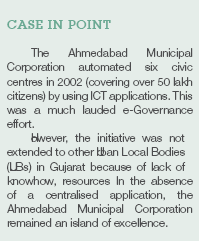 Development (MoUD) has issued a set of guidelines to various state governments for implementing e-Governance, and also prepared a model Detailed Project Report (DPR), the Ministry did not lay down a specifi c solution to be deployed. The result is that, though all municipalities have to offer a common set of eight services (minimum), they all follow different technology designs. This diversity is likely to create a serious human resource issue. Employees of ULBs are routinely transferred across different municipalities within a State. Such people have to deal with different solutions at each end. Also, at the district level, specialised technology resources are hard to come by.
Another serious issue is the lack of learning from the implementation in seven mega cities, which are in advanced stage of e-Governance readiness.
The conclusion is that standardisation eliminates learning curve and increases effi ciency – and is the need of the hour as far as e- Governance is concerned.
SHIFTING GEARS AND PERSPECTIVE – AN IMPERATIVE
The ideal scenario for e- Governance would be one common application for all the 5,000 Urban Local Bodies (ULBs). However, variation in law across different states and 22 offi cial languages make such a common application unviable.
Also, ULBs are typically of three types – city corporation (nagar nigam), city councils (nagar palikas), and town councils (nagar panchayats) – which are governed by a State Municipal Act and this Act devolves different levels of autonomy to different category of ULBs.
Given the diversity across the country, the solution would be to adopt one application for each State. And a centralised application in each State would handle all ULBs in that State. Cloud Computing is best suited to this scenario.
THE BENEFITS OF CLOUDCOMPUTING
1. Evolutionary and enabled by a number of existing technologies, such as virtualisation, automation, and self-service portals
2. Virtualised and dynamically scalable resources are provided as a service over the Internet. This means that users do not need to have knowledge of the technology infrastructure in the “cloud” that supports them. This aspect is very important considering that technology resources are hard to obtain at a district level.
3. ‘Greening’ of the data center through centralised and shared infrastructure
4. Reduced cost of infrastructure, platforms, and applications, as municipalities within state can share services like network, security, IT help desk support, facility management
CONCLUSION
To sum up, cloud computing at the state level (vis a vis independent deployments at local body level) is the answer to wide spread adoption of eGovernance in local bodies due to the following:
1. Lower cost of development
2. Less complex technical manpower requirement for maintenance of application software
3. Lower roll-out time
4. Cost reduction as urban local bodies can use the State Data Center and State Wide Area Network for hosting applications
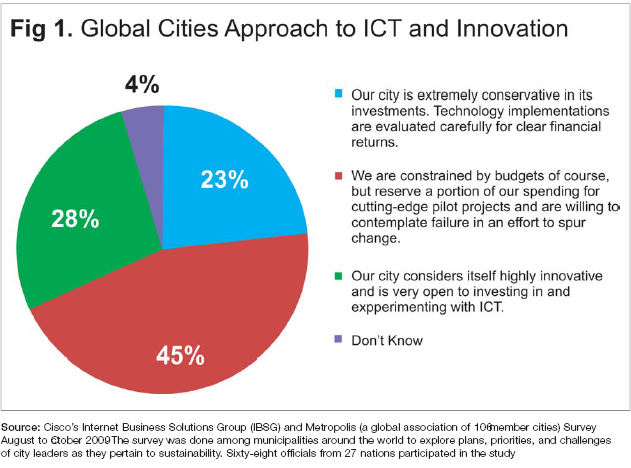
Clearly cloud computing can provide the strategic leverage needed by Indian States to take the power of e- Governance to India’s masses. The Cisco-Metropolis study points to an interesting trend where 45% of respondents (fi g. 1) consider their cities responsive to technology innovation. It is in this positive outlook that cloud computing’s success in transforming local governance lies.