


Is AI-driven governance only the responsibility of governments? Clearly not. The real impact comes when educational institutions build AI-ready talent and private players deploy solutions at scale from smart mobility systems and predictive utilities to fintech, logistics, and health platforms already shaping daily governance outcomes. When academia, industry, and government move together, AI stops being a pilot and becomes a public asset.

Artificial Intelligence in India has moved beyond experimentation to become a functional layer of governance and economic execution. Across taxation, welfare delivery, transport, urban services, and trade facilitation, AI is now embedded into daily administrative decision- making, shifting governance from reactive response to anticipatory management.
This transition is already delivering measurable outcomes. AI-enabled analytics under the GST Network (GSTN) have significantly improved detection of fake invoicing and input-tax-credit leakages, with the Ministry of Finance acknowledging that technology-led risk profiling has helped identify irregularities worth several thousand crore rupees in recent years. Similarly, Aadhaar-linked AI validation has reduced duplication in welfare delivery, strengthening the integrity of direct benefit transfer schemes such as PM-KISAN and social security pensions.

On Delhi’s Dwarka Expressway, an AI-powered Advanced Traffic Management System monitors a 56+ km corridor, detecting 14 types of traffic violations in real time to enhance road safety and reduce congestion for commuters and freight operators alike. In Lucknow, over 1,300 AI-enabled cameras across 250 public safety nodes recognise distress gestures and suspicious behaviour, rapidly alerting police to incidents such as assaults or accidents, and integrating facial recognition from criminal databases to boost response readiness. These practical, everyday applications reflect broader national moves to embed AI across governance.

India’s government has identified core platforms such as the India Urban Data Exchange (IUDX), Ideal Train Profile for optimising train berth utilisation, and AI chatbots like Digidhan Mitra that assist citizens with financial transaction insights and personalised service navigation. National policies such as the IndiaAI Mission and evolving AI governance guidelines emphasise ethical, inclusive deployment of AI as public infrastructure, ensuring it serves citizens reliably while respecting data privacy and fairness.

Urban governance offers another clear illustration. Cities including Bengaluru, Hyderabad, and Pune deploy AI-driven traffic signal optimisation, reporting 10–15% reductions in intersection delays and improved fuel efficiency. Indian Railways, operating one of the world’s largest rail networks, uses AI-based predictive maintenance for tracks and rolling stock, reducing unscheduled failures and enhancing passenger safety for over 23 million daily users. In public health, AI-assisted screening tools are now part of government pilots for early detection of tuberculosis and certain cancers, enabling earlier intervention in high-burden districts.

The food safety ecosystem is also seeing AI gains. The Food Safety and Standards Authority of India (FSSAI) has piloted machine vision and natural language processing to identify adulteration patterns in milk and edible oils. Early results indicate a significant improvement in laboratory triage efficiency, enabling quicker action against unsafe batches and protecting public health in segments that account for over `2 lakh crore in annual consumption.
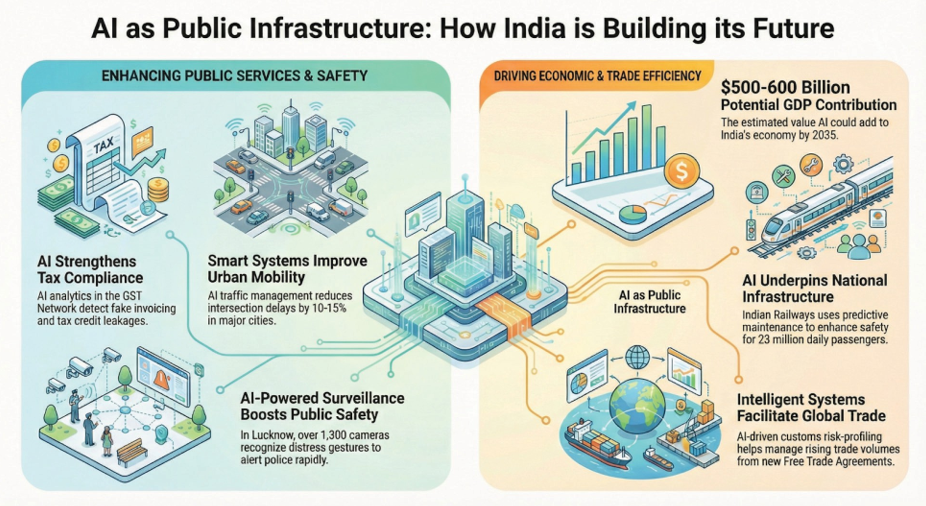
The economic relevance of AI-driven governance has grown further with India’s recent Free Trade Agreements with the UAE, Australia, New Zealand, and the European Union. While these FTAs expand market access on paper, AI ensures execution on the ground. Customs risk-profiling systems, AI-supported logistics planning, and digital grievance platforms are reducing clearance times, strengthening compliance, and improving trade integrity as tariff barriers fall. With the India–EU FTA granting preferential access across nearly 97% of tariff lines, predictive systems are essential to manage rising trade volumes efficiently.
AI-enabled ports, cities, and regulatory platforms are supporting exporters in textiles, leather, marine products, engineering goods, chemicals, and plastics, while MSMEs, contributors of nearly 30% of India’s GDP, benefit from data-driven credit assessment, compliance support, and market intelligence. This convergence of trade openness and intelligent governance is increasingly shaping India’s competitiveness in global value chains.
At the macro level, global studies estimate that AI could contribute USD 500–600 billion to India’s GDP by 2035. However, the immediate impact is already visible in better asset utilisation, faster administrative decisions, lower operating costs, and investment- ready cities and states. Predictable service delivery-whether in utilities, transport, customs, or urban logistics—has become a decisive factor in attracting investment into manufacturing, infrastructure, clean energy, and logistics.
Also Read | Weaving AI Into Odisha’s Craft Legacy
India’s approach to AI in governance is anchored in problem- first deployment, ethical safeguards, and institutional integration, guided by national frameworks under Digital India, the IndiaAI Mission, and MeitY’s policy direction. AI does not replace institutions; it strengthens their capacity to deliver at scale. As adoption moves from pilots to system-wide deployment, AI is steadily emerging as public infrastructure, critical to governance credibility, economic execution, and citizen trust.
Views Expressed By: Shri M Nagarajan, Municipal Commissioner, Surat Municipal Corporation, Surat