


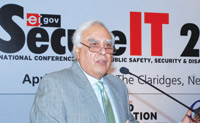
 Kapil Sibal
Union Minister for Communications and Information Technology

With the advent and proliferation of information and communication technologies, the world will be interconnected through a cyber system, in the coming years. The world will know no boundaries and there will be information flow from one part to another. The cyber infrastructure will let the world communicate with each other. When the cyber infrastructure is put in place, the way we interact with each other and the way we build our development processes will be far easier than it is now and the citizens will be truly empowered. That of course is the objective of the ICT revolution. It ultimately leads to the empowerment of the citizen, who has no information and thus cannot exercise his constitutional rights.
I have, therefore, always believed that the right to information (RTI) should be a part of right to free speech. Unless RTI is made part of right to freedom of speech and expression, information will be a commodity and will not be available as freely as it should be. A farmer, who is tilling his land or harvesting his crop, must know when he should go to the market. He must also have weather information from the weather department through GIS technology. He must know what will be the quantum of rain that his field is going to get. Similarly, fisherman must know when he should go out and fish. He should know which part of the ocean has chlorophyll and which does not. The general public must have information on when a Tsunami is going to hit.

One of the reasons why the Japanese were able to protect themselves was because of their technological advancement. They have made the most modern early warning systems for Tsunami. The authorities were able to tell one minute in advance that a tragedy of this sort of monumental proportions is going to happen, during which 20,000 people lost their lives and communities and infrastructure were destroyed. The challenge India faces is that, we have a nuclear problem on our hands, like the Chernobyl disaster that took place many years ago.

Looking at the positive side, things could have been much worse had Japan not been having the early warning system in place. I remember when the Tsunami hit us we had no system in place. It was sometime in December 2004 that the Tsunami hit us and we vowed that by September 2005 we will have an early warning system for Tsunami in place in India. We did deliver the system to the people of the country in September 2005 at a cost of `120 crore.

This system is one of the most modern systems of the world. In fact, Indonesia, Australia, our neighboring countries, Sri Lanka and others are all connected with it now and we can share the information with all these countries. If there is an earthquake of a magnitude of 9 or more and there is a displacement of land mass then it causes the water, underneath the ocean, to swell and it results in tidal waves. It will take four hours for those tidal waves to reach the Indian coast and with this system in place, we will have enough time to prevent the disaster.

We are also enabled to predict other parameters such as, when the Tsunami occurs which part of the eastern coast it will hit first, which cities it will hit, what will be the extent of destruction, when will the waves recede and which parts of the territory of the east coast can be identified from where it can recede. Therefore, we will be able to manage the consequences of Tsunami, as well. This technology allows you to detect and determine, which properties will get damaged and which won’t.
This is just one example of how ICT revolution is going to overtake us in the coming years. The other aspect is that we have today one of the largest communication systems in the world. We have so many satellites in place. We also have remote sensing agency, which is exceptionally efficient.
Through spatial technologies we can have a lot of ICT products, which can be used in the market, not just for disaster preparedness but other things as well, for instance, criminal or intelligence network. All these investigative agencies track some case or the other and have their data but the data is not communicated or seamless. If we want to build a national intelligence network then we have to make sure that all this data is interactive.
As you know India is setting up a national Intelligence Grid and one of our objectives is to ensure that the connectivity of various intelligence agencies and will also link enforcement agencies as sometimes enforcement agencies don’t have access to information with intelligence agencies and vice versa. This national grid will leverage all the collective information to optimum use.
Once you move from a paper to a paperless world it becomes your critical infrastructure for most of the operations and so you need to protect it. There will be lots perpetrators who would want to hack in the system and destroy it. This will be in the context of a war, this will be in the context of commerce to destabilise the internal mechanisms of departments of countries to ensure people are relegated to a state of confusion. In such a state protection of that infrastructure is required and we need IT solutions for it. I am sure that in the times to come these solutions will evolve. Telecommunications is the delivery mechanism but the real content must come from IT.
We in India are concentrating on delivery and not concentrating on content. So you may have another 500 million mobile phones and broadband connections in place connecting every village and district but if we do not have the content then it’s of no use. We must shift our emphasis on creating IT solutions. It is much beyond just cyber security or disaster management; the entire developmental process is baseless without content. We are going to connect 26,000 colleges and 700 universities in the next two years through the national knowledge network. In addition to this, however, we need open source material and content to actually empower the students. I believe, this is a great opportunity for the IT industry.
Also, if you marry IT with GIS you will have a product that will be the most empowering product in the world. Imagine if a child sitting in Mohali wants to know his/her prospects in a college in Hyderabad, through GIS he can look at images of the college and can actually walk through the college and decide.
We are at the cusp of an entirely new revolution in this country. We will be the world leaders I can promise you that, because no one has the enormous capacity that India has. By marrying information technology with human resources, we can build solutions tomorrow. No other country has human resource, advanced information technology or even a basic network of the information technology that we have. If you go to a country like Taiwan, they are very net-savvy, very tech-savvy but they don’t have any young people; same is with Korea; South Korea has no people. So, where there is technology, there are no people, no human resource and where there is human resource there is little technology. India is perhaps the only exception, where we have the combination of very high quality human resource with advanced technology and a satellite communication network which can match anyone in the world. I can only say that to actually achieve the above, if you walk 5 steps I will walk 10 steps ahead with you.
Excerpts from Kapil Sibal’s speech at Secure IT 2011
For full speech please log on to: secureit.eletsonline.com