


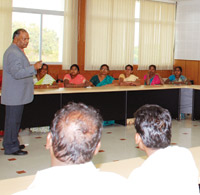
 APARD has initiated an e-learning model to hold the instructors, field officers and interested members of the public together in a learning community

The organisation
APARD (Andhra Pradesh Academy Of Rural Development)
Key People

Phani Kumar

PROBLEMS AND CHALLENGES

-
To create e-Learning Solutions for heterogeneous groups of people (Literate, Semi Literate and illiterates)
-
To resolve impedients that block adoption of e-Learning in rural areas including lack of power, connectivity and computer usage
-
Need for a scalable learning model that could meet training demand as per the learner group size
By Pragya Gupta egov Bureau

More than 70 percent of India’s population lives in rural areas. Educating people in rural areas is essential for substantial development and rural economic competitiveness of our country. At the same time issues of equity, quality and access remain areas of concern. However, ICT in education is fast emerging as a solution for transforming education and percolating learning to remote rural areas.
For rural empowerment, it is mandatory to empower those who are appointed as the agents to bring change to the rural areas. Following the wind of change, Andhra Pradesh adopted e-Learning for rural empowerment.
The Andhra Pradesh Academy of Rural Development (APARD) is the apex training institute in Andhra for capacity building of rural development officers and Panchayat Raj officials. The institute, consistently focuses on research to offer high quality consulting services in rural development, has initiated an e- learning project and a number of e-Learning products have developed for various target groups for continuous learning.
Highlighting the importance of ICT for capacity building of rural development officers, Phani Kumar, Former Commissioner, APARD said, “In Andhra Pradesh, we have about 2.61 lakh elected representatives of Panchayati Raj Institutions. There are another two lakh of mates and field assistants working for NREGP. We can deliver face-to-face training to them once a year in a cascade mode for about three to four days. If we have to deliver training for more days, then it has to be only using IT and relevant androgogy,”
Solution
To accomplish the task of addressing such a diversified stakeholders (literate, semi-literate and illiterates), APARD developed its own Learning Management System (LMS). “We have used Moodles as the LMS. For the semi-literate, we have used books in the comic book format like Amar Chitra Katha, Phantom or Tarzan. For the illiterate, it was completely through audio-visuals.”
APARD wikis were formed for collaborative learning. The difference between the teacher and the taught will be reduced, if not eliminated. WEB 2.0 technologies enabled them to depart from traditional androgogy. PR comprehensive helpline consists of a traditional helpline using a BSNL phone line, and USHAHIDI technologies have been incorporated. People can lodge their complaint through phone, email, SMS or register on the website. As Google maps are a part of the USHAHIDI system in use, APARD also states the location of the complainant. “We have encouraged our instructors to use the helpline for clearing doubts of participants if the instructors do not know the answers themselves.
Rural development through e-Learning
The Andhra Pradesh Academy of Rural Development (APARD) has initiated an e-Learning model to deliver its courses on rural development to officials at district and state level, elected representatives of Panchayat Raj and farmers primarily, to hold the instructors, field officers and interested members of the public together in a learning community. A lot of bonding has taken place between them,” added Kumar.
APARD has also taken the route of offline training with manuals, illustrated books, CBTs etc. For online tools like WBT (web-based tutorials,) wikis, and e-Books and educative movies on Youtube are being used. Content posting on the web has saved the trouble of running out of print while training. APARD’s LMS site is called Knowledge Commons.
On the acceptance of the training, he commented, “It is really amazing to see how willingly and easily people adapted themselves to new ways of capacity building. Computer and telecommunication penetration, above all, mobile penetration in rural areas has been responsible for this acceptance of new technologies. Mobile phones have taught them how to download caller tunes, ring tones and upload pictures, etc.”
Multimedia content helped this project as it is easy to develop multimedia content and transfer it to any location. Kumar said that APARD has copied content from their CBTs onto SD and micro SD cards and gave them to participants to use them in their mobiles at their leisure. “It is much more fun to watch a video or listen to a podcast than to read a book,” said Kumar. APARD collaborated with HCL in creating and deploying e-Learning courses on rural development. The courses were designed considering the low literacy rates of rural development as well as its implementation in hard to reach village areas of Andhra Pradesh.
Monitoring
Firstly, APARD has monitored the use of this content through our machinery. Then the third party assessment was subjected by Administrative Staff College of India (ASCI), Centre for Economic and Social Studies (CESS), and National Institute of Rural Development (NIRD). This project’s main deliverable is bringing about an acceptable change in the mindset of participants regarding self paced electronic learning. I think we have achieved that, by and large.
APARD organised a workshop to build a collaborative learning community in October, 2010 with the selected group of officers to build a community of learners. “The October 10 workshop was organised with intent to make APARD, a learning organisation. We wanted to develop champions of this cause.”
ICT and multimedia-enabled APARD is delivering credible, stimulating and relevant training to the diversified target audience. e-Learning enables one to gain subject knowledge anytime and anywhere without any geographical barriers and empowers learners through access to a wide range of learning resources both online and offline.