
News
Bihar Cabinet Approves 500 MW Rooftop Solar Project, Clears 22 Key Development Proposals
Bihar Cabinet Approves 500 MW Rooftop Solar Project, Clears 22 Key Development Proposals
![]() By
Elets News Network
By
Elets News Network


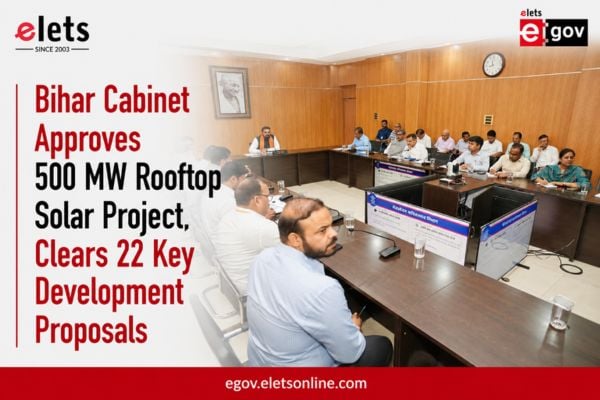
The Bihar Cabinet has approved a series of major development initiatives, including a 500 MW rooftop solar project to be installed on government buildings across the state over the next five years. The decision was taken during a Cabinet meeting chaired by Chief Minister Samrat Choudhary, where a total of 22 proposals received approval.

The initiatives span renewable energy, agriculture, transport, urban development, education, healthcare, and dairy infrastructure, reflecting the state’s focus on sustainable growth and improved public services.
500 MW Rooftop Solar Project Gets Cabinet Approval
One of the key decisions was the approval of a 500 MW rooftop solar programme, which will be implemented on government buildings between 2025-26 and 2029-30.

The project aims to reduce electricity costs for government institutions while increasing the use of clean energy across the state. By generating solar power on-site, the government expects to lower dependence on conventional electricity sources and strengthen Bihar’s energy security.

Project to Be Implemented Through RESCO Model
The rooftop solar initiative will be executed under the Renewable Energy Service Company (RESCO) model.
Under this framework, private developers will install and maintain the solar power systems using their own investment. Government departments will purchase the electricity generated through long-term power purchase agreements, eliminating the need for significant upfront capital expenditure.

Officials believe this model will help accelerate the expansion of solar energy infrastructure while ensuring efficient operation and maintenance of the plants.
Focus on Clean Energy and Cost Savings
The government expects the project to deliver multiple long-term benefits, including reduced electricity expenditure, increased renewable energy adoption, lower carbon emissions, and improved environmental sustainability.
The initiative also aligns with the state’s efforts to promote cleaner sources of energy while meeting growing electricity demand through sustainable solutions.
Cabinet Clears Agriculture and Fisheries Initiatives
Apart from the solar project, the Cabinet approved the Dalhan Self-Reliance Mission with an allocation of ₹79.84 crore to enhance pulse production and reduce dependence on imports from other states.
It also approved ₹154 crore under the Digital Agriculture Mission, which will support farmer registration, digital crop surveys, and technology-driven agricultural services to improve planning and service delivery.
To strengthen the fisheries sector, the government approved the formation of the Bihar Aquaculture Infrastructure and Development Corporation.
In the dairy sector, support was sanctioned under COMFED for the installation of bulk milk coolers and modern milk testing equipment to improve milk collection and processing infrastructure.
Greenfield Townships and Transport Projects Approved
The Cabinet also approved land acquisition for the development of greenfield satellite townships in Patna, Sonpur, Gaya, and Muzaffarpur to support planned urban expansion.
In the transport sector, approval was given for the preparation of Detailed Project Reports (DPRs) for Regional Rapid Transit System (RRTS) corridors at four locations. Additionally, ₹126.25 crore was sanctioned for the repair and strengthening of the Vikramshila Bridge, aimed at improving road connectivity in the state.
Education and Healthcare Receive Major Boost
Several important proposals were cleared to strengthen education and healthcare infrastructure.
The Cabinet approved the extension of the Mukhyamantri Nishchay Swayam Sahayata Bhatta Yojana until 2030-31. It also sanctioned the creation of 76 new teaching posts for M.Tech programmes in engineering colleges.
In the healthcare sector, land acquisition was approved for the expansion of AIIMS Patna, while land was also allocated for establishing new Kendriya Vidyalayas in Madhubani, Munger, and Muzaffarpur.
Government Pushes Sustainable Development Agenda
The Cabinet’s decisions underline Bihar’s emphasis on balancing economic development with sustainability. From expanding renewable energy and strengthening agriculture to improving transport, education, healthcare, and urban infrastructure, the approved proposals are expected to support long-term growth while enhancing public services across the state.

Be a part of Elets Collaborative Initiatives. Join Us for Upcoming Events and explore business opportunities. Like us on Facebook , connect with us on LinkedIn and follow us on Twitter, Instagram.
"Exciting news! Elets technomedia is now on WhatsApp Channels Subscribe today by clicking the link and stay updated with the latest insights!" Click here!