
Artificial intelligence is emerging as a key enabler in strengthening India’s healthcare system by improving clinical capacity, enabling early disease detection, and supporting data-driven policymaking. With the digital public infrastructure under the Ayushman Bharat Digital Mission and large-scale health data generated through PM-JAY, AI is being positioned as a tool to enhance the productivity of doctors, nurses, and frontline health workers while reducing long-term healthcare costs. Dr. Sunil Kumar Barnwal, IAS, Chief Executive Officer, National Health Authority, Government of India, shared insights on AI in healthcare with Priyanka Dua of Elets News Network on the sidelines of the recently concluded UP AI & Health Innovation Conference in Lucknow. Edited excerpts:
You have attended the UP AI and Health Summit. What are the key takeaways?
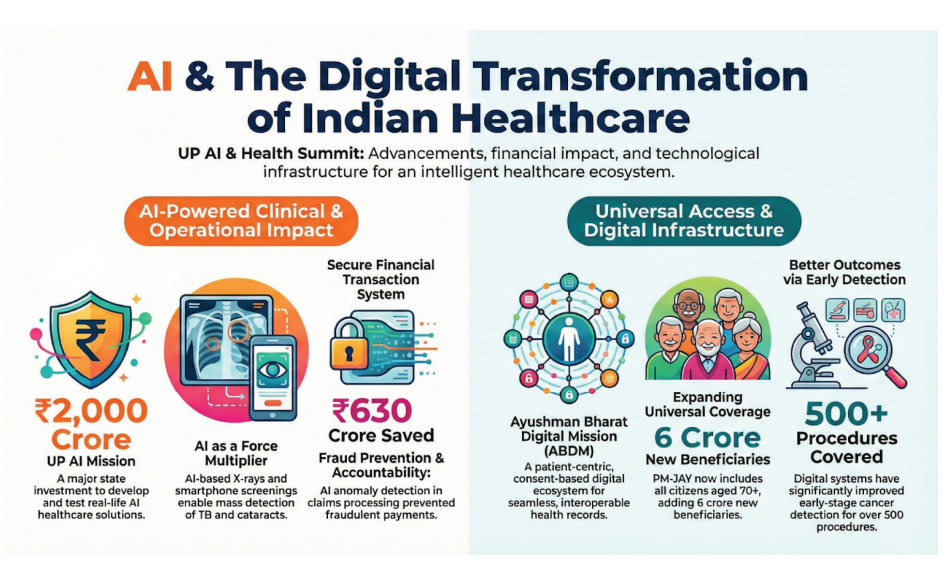
The UP AI and Health Innovation Conference has delivered several important takeaways. These emerged not only from the inaugural session—where the Chief Minister of Uttar Pradesh announced the `2,000 crore UP AI Mission— but also from the technical sessions that followed.
I chaired a session on the state of AI in Indian states, and it became clear that states hold immense potential not only to develop AI solutions but also to test them in real- life settings. A key takeaway is a deeper understanding of the value AI brings to healthcare—how it enhances the capacity of doctors, nurses, and frontline ASHA workers, while improving clinical effectiveness through decision support systems, disease surveillance, and workflow optimisation.
These insights are valuable both for health-tech companies developing AI solutions that need real- world datasets, and for states that can leverage AI to strengthen capacity, empower frontline workers, and generate actionable intelligence for administrators and policymakers.
This summit is also a pre- event to the AI Impact Summit in February. How significant is it in that context?

This conference is extremely important as a lead-up to the AI Impact Summit. It offers practical insights into how states can use AI, particularly in healthcare. The participation from multiple states and stakeholders, along with high-quality discussions, has resulted in meaningful outcomes. Overall, it has been a very useful and impactful conference.
What role is the National Health Authority (NHA) playing in this summit?
On behalf of the Ministry of Health and Family Welfare, the NHA not only implements the Ayushman Bharat Pradhan Mantri Jan Arogya Yojana (PM-JAY)—the world’s largest government-funded health assurance programme—but also the Ayushman Bharat Digital Mission (ABDM).
Under PM-JAY, we have built a robust, flexible, and scalable IT platform for health coverage. While it began as a Government of India programme, many states have since onboarded their own health insurance and assurance schemes onto the same platform. This is the national vision—develop a common platform and enable states to collaborate and benefit from it, rather than developing isolated solutions.
Through ABDM, we have created a digital public infrastructure for health that is open, interoperable, and federated. There is no central data repository; instead, data remains with the source, and access is enabled through consent. This allows health systems across the country to communicate seamlessly, empowering patients and enabling innovation.
How does this digital infrastructure help patients directly?
ABDM places the patient at the centre of the healthcare ecosystem. With patient consent, health records can be securely shared across systems, allowing individuals to build longitudinal health histories. This not only empowers patients but also supports predictive and preventive healthcare, as well as early disease detection.
Evidence shows that digital health systems under PM-JAY have significantly improved early disease detection, reducing both patient suffering and healthcare costs.
PM-JAY has been cited for improving early cancer detection. Could you elaborate?
Yes. The Economic Survey 2024–25 clearly highlights that early-stage cancer detection has improved significantly due to PM-JAY. More than 500 cancer-related procedures are covered under the scheme.
Earlier, many people viewed a cancer diagnosis as a financial and emotional dead end. Today, patients are accessing treatment at early stages, which provides not only financial security against catastrophic health expenditure but also confidence and empowerment. This has led to improved health- seeking behaviour, especially among underprivileged populations.
Is PM-JAY limited only to below-poverty-line beneficiaries?
No. PM-JAY covers the bottom 40% of the population, identified through socio-economic deprivation criteria. States also have the flexibility to use Aadhaar-seeded databases, such as the National Food Security Act data or their own family databases.
Additionally, PM-JAY now provides universal coverage for all citizens aged 70 years and above, irrespective of socio-economic status, adding nearly six crore beneficiaries. ASHA workers, Anganwadi workers, and their families have also been included. Gradually, India is moving towards universal health coverage, with around 13 states nearing that stage through their own schemes integrated with the PM-JAY IT platform.
From a digital health perspective, which states are performing well?
We do not benchmark states competitively. Digital health success depends more on hospitals and patients than on geography. Empowering patients through ABHA IDs, enabling hospitals through HMIS, and linking health records are the real indicators.
That said, states play a crucial role in promoting ABDM adoption. Most states are progressive, but the focus now is on creating use cases that encourage hospitals and patients to actively use digital health systems.
Healthcare is often the first sector associated with AI. Why is that?
Healthcare faces significant challenges, especially in secondary and tertiary care. From a health economics perspective, early disease prediction, preventive care, and early detection— enabled by AI—can drastically reduce long-term healthcare costs.
AI improves workflows, enhances clinical capacity, and acts as a force multiplier. For example, AI-based X-ray analysis can indicate tuberculosis, and smartphone-based eye screening can detect cataracts at scale. This allows mass screening using the same workforce, which is critical for a country as large and diverse as India.
Are there plans to replicate this kind of AI and health collaboration in other states?
This event was supported as a pre- summit initiative under the India AI Mission and through the NHA. There is certainly a need to organise similar events across states. AI is now a reality, and the focus must be on deploying it responsibly. I am confident that many states will come forward to organise such initiatives.
AI-related fraud is also a growing concern. How is NHA addressing this?
AI has been instrumental in detecting fraud under PM-JAY. Using AI-based anomaly detection in claims processing, we have prevented fraudulent claims amounting to nearly `630 crore. This not only saves public money but also creates accountability among hospitals.
At the same time, AI solutions must be tested rigorously. A solution trained on limited or localised datasets may produce misleading results elsewhere. That is why, in collaboration with IIT Kanpur, we are developing an AI testing and benchmarking platform. We are also organising hackathons where solutions are tested against large, diverse datasets to ensure they are effective in the Indian context.
What challenges have you faced since joining NHA?
The biggest challenge is adoption— getting more hospitals to use ABDM- enabled HMIS, integrating with the National Health Claims Exchange, and generating structured electronic medical records. AI cannot function effectively without high-quality, structured data. We also need to incentivise both public and private hospitals to adopt digital systems. While these are challenges, they are also opportunities to leapfrog into a more integrated, intelligent healthcare system.
Finally, what is NHA’s vision looking ahead to 2026?
NHA’s long-term vision is to deliver integrated healthcare to a large population through a strong digital ecosystem. By 2026, our focus will be on accelerating digital health adoption while efficiently running the world’s largest government-supported health assurance programme. The goal is to make healthcare delivery more effective, intelligent, and patient- centric.