


Meera Balachandran, Principal, Ramjas School, R.K. Puram believes that ICT in education is very useful. She is emphasising about the teacher training and takes measure to keep the teachers at her school updated with the ICTs and in many other fields. The school has the training facilities that aims to train teachers, students and to develop research-based projects including Maths lab and to improve speaking skills.

 Balachandran says, the biggest challenge today in education is keeping one updated. “Because knowledge is expanding at a very fast rate. If the teachers and the students are not updated they will be left behind.” She strongly supports the idea of self learning, letting the students learn on their own where the teacher is just a facilitator. On the contrary, most teachers like to teach rather than leaving the children find the answers on their own, she added.
Ramjas school has come up with the novel concept of dynamics clubs: computer based clubs that the students run themselves. The clubs are exclusively managed by the students, who also maintain the website of the school. These clubs organise inter school competition every year that are crucial in the capacity building of the students. Ramjas has been one of the preveliged schools that has been offered a complete set up by Intel with 15 computers.

‘For the primary school we are planning to keep15 laptops at the headmistress office.’ We roll it in the class. The children pick up the laptop, work within the class room and they don’t come out of the class.

The training programme is developed by the teachers only in collaboration with the students. We dont collaborate with any other external organisation in developing such programmes.

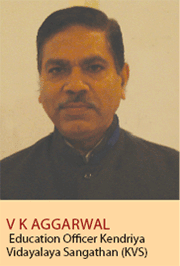
Kendriya Vidayalaya Sangathan (KVS) has over 1000 schools across the country and one each in Moscow, Kathmandu and in Tehran. Elaborating on the use of ICT in School educat ion, V K Aggarwal says that ICT will supplement to formal education by ways of disseminating information, facilitating lifelong education, etc. But it should not be the hub of everything. There is a need to bring about a change in mind. ‘Why we think that we can not do anything without ICT? We should realise that ICT is a solution provider and not solution generator. They are not empowering the children to generate the solution. This is where we are lacking.’

At the initial level, the children should not be exposed to the ICT assisted education, atleast up till class 6. Aggarwal holds such an opinion because he believes that ICT integration in the early year of a child’s education kills the thinking skills of the kid for the simple reason that when a kid gets a readymade solution for everything he stops thinking. This is the time that they should be exposed to the natural learning. ‘If we are exposing them to the ready made learning we are shunning their skills.’
 The KVS officer again says initially KVS didn’t have computers and other ICTs upto class six. But when it was decided to introduce ICTs in class 3 onwards, it was found that there was a significant difference in the original thinking power in the children of class 5 who come from class 3 with ICT exposure and those without ICT exposure. He also added that when an application based problem was given to them which is not a part of their text, the children who were not exposed to computers were able to solve them quickly as compared to those who were exposed to ICT. Nonetheless, he advocated its use for making children learn dawning, MS Paint and other thing of that nature. One strong reason he put forth against early exposure of ICT to children is on the ground of socialisation. Children exposed to ICTs are engrossed with their computers so much that they hardly find time to play and attending social gatherings. He added that children should come up to that level where they are able to filter it down and know what is relevant and what is not. But its unfortunate that its not been observed.
He emphasised on building a healthy, positive relationship with the child and have a firm belief that every child has the potential to learn. Putting forth the recent recommendations by NCERT favouring constructivist approach for teaching, Aggarwal says, children should be allowed to do on their own and let them find out the thousand ways and means things can be done. There can be different meanings things have for different children rather than giving a unified particular solutions for all the problems.
Sharing his concern on quality education, Aggarwal says, quality has got as many meanings and is as diverse as the diversity in India. Most people speak of quality in terms of achievement in examination, that alone is not quality. Rather it consists of several criteria through which the so called test marks of the child can be increased. A child who secures 90% marks is no better than that who scores lesser, but has got better value education and knows how to support learning in terms of knowledge. Thus the parameters for quality in education should be the understanding of the child, whatever he is being taught. He appears of the opinion that an increase in budget for education sector is critically significant to reach out to those who are out of education. There is need to reach to the unfocused and deprived areas. He said quality will always carry the quantity with it. If you increase the quality, quantity will come along. But are we able to provide enough quantitative schools? Still millions of children are unable to access education and are not enrolled to schools. Every year, primary schooling for a person earns about 30% of his productivity. We need to look for that quality.
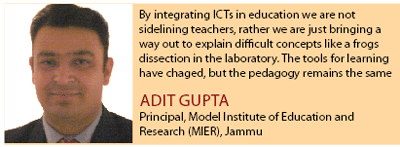
 Adit Gupta, the Principal, MIER – a 67 years old institute in Jammu feels that any new technology introduced in education will face many hurdles. But he believes that every hurdle can be overcome. Gupta pronounced teacher training to adequately equip them to cope up with the changing trends and innovations in the education field. He sounded positive regarding the increased budgetary allocation and said, its is in the right direction. But added, planning and management of the funds is of utmost importance and more efforts need to ensure whether the funds are going in the right direction.
Gupta accents upon achieving the ultimate goal of satisfying the customers. We need to ask this question if the students are satisfied with the current education practices and whether they are positively contributing in their learning and building capacities. Sharing his own experiences in school education he says, it has been observed that children using ICTs are more interested in education, more curious and inquisitive to learn. Referring to a study in his own school he said, ICTs impacts positively in Science education, and the results are great.
By integrating ICTs in education we are not sidelining teachers, rather we are just bringing a way out to explain difficult concepts like a frogs dissection in the laboratory. The tools for learning have chaged, but the pedagogy remains the same. ICTs should be an integral part of every teacher training programme and in courses like B.Ed. Teacher Training paper should be made compulsory in the course as this would save resources that are spent on teachers on job.
ICT integration in the early year of a child’s education kills the thinking skills of the kid for the simple reason that when a kid gets a readymade solution for everything he stops thinking. This is the time that they should be exposed to the natural learning
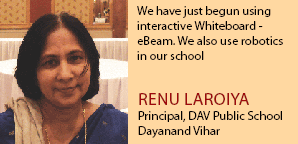
We are using laptops, projectors, LCD, T V in classrooms that is connected with the central knowledge lab. We are in collaboration with Educomp for the last 3 years that provides us content and training for our staff. Gupta added that universtatlisation of education can only be possible through ICTs. Renu Laroiya thinks, ICTs in school education naturally is of great use. It makes the teaching learning process very interesting and easy. In our school ICTs help teachers in ways like preparing teaching learning material; teachers make lessons on the computers. Computers make the whole process of teaching learning very effective. The most interesting part of it is that both teachers and students take keen interest and get involved in the education process. Even the most hyper active student who otherwise disturbs the whole class are converted into the most disciplined ones.
There are other technology also that are used in our school, other than the computers. ‘We have just begun using interactive Whiteboard – eBeam. Its really helpful and will greatly enhance the teaching learning at the school. Students and teachers take great interest in the tool.’ But it will take some time before we could fully utilise the tool, as its quite new to us. We also use robotics at our school, which is again of great use.
Whenever a new technology is implemented, there is always an initial resistance on part of the teachers. To overcome this, I think teacher training plays a very important role in making them understand the benefits of using technology in education and how these tools can make the whole process of teaching learning more effective. Increased budgetary allocation by the government will also influence the process as it will boost up the morale of the teachers and the students as well.