




The Sixth Annual Ingternet Governance Forum (IGF) was held from 27-30 September 2011 at the United Nations Office at Nairobi (UNON), Kenya. The theme of the meeting was: ‘Internet as a catalyst for change: access, development, freedoms and innovation’.
Accessibility and Diversity of Broadband Internet Access

The Internet is increasingly being recognised as one of the key enablers of growth and development. The growing recognition that the Internet is a public good is evident from the fact that a number of countries, starting with Finland in 2009, have made access to broadband Internet a fundamental right. As connectivity becomes an ever-more important determinant of access to development, and as calls for, and concern towards, inclusiveness in the development process grow stronger, it is pertinent to identify and address the key issues affecting connectivity. It is equally important to then address the issue of access and ability to use information – which is currently handicapped in large measure due to literacy and language-related factors. With this objective the Centre for Science Development and Media Studies (CSDMS) organised a workshop on ‘Accessibility and Diversity of Broadband Internet Access’ at the sixth IGF meeting.

Chaired by Sh N Ravi Shanker Additional Secretary, Department of Information Technology, Ministry of Communication and Information Technology, Government of India; the prominent panel members of the workshop included Graciela Saleimi, instituto NUPEF, Brazil; Klaus Stoll, Acting Executive Director, Global Knowledge Partnership Foundation; Venkatesh Hariharan, Head of Public Policy and Government Relations, Google India; Sunil Abraham, Executive Director, The Centre for Internet and Society; and Abhishek Singh, Director, Department of Information Technology, Ministry of Information Technology, Government of India.

Discussions

Dr Rajeshree Dutta Kumar, Sr Programme Specialist, CSDMS introduced the session theme by highlighting the importance of broadband Internet access. She stated certain key issues that constrain use of broadband including high cost, connectivity and broadband in rural areas, language in which Internet is organised, access issues for illiterates and visually challenged, control of Internet and root servers, net neutrality and compatibility IPv6.
Graciela Saleimi put forth issues related to broadband internet access in Brazil. She said, “Brazil has 12.8 million broadband connections with an average monthly cost of USD 93. This accounts for 4.5 percent of the monthly per capita income of a Brazilian citizen, which is much higher as compared to the developing countries which have an average monthly spend of 0.5 percent of the per capita income. Half of Brazilian municipalities do not have access to broadband connections, which is a critical issue that the government needs to address.”
Klaus Stoll was of the view that digital divide does not exist as the unavailability of broadband mainly exists in areas where there is no awareness and demand. He highlighted the importance of strategic use of Internet across the world.
Talking about policy related issues, which are critical for Internet access, Venkatesh Hariharan said, “There are investments and networks in pipeline which is good news but the governance of those networks, the rule of law, the processes of law that manage these networks is also very important.”
Another critical issue that hampers the accessibility of internet is copyright laws. Focussing on this, Sunil Abraham said, “A technology solution must be made a legitimate solution, barring all copyright issues, if it offers enough value. We must also look into the patent issues to make it easier for compliance. Free and open source licenses must also be considered for enhancing access.”
Bringing forward the Indian context, Abhishek Singh said, “The government in India is setting up 100,000 kiosks in villages and rural areas, which can provide Internet connectivity in these regions. More than 60 percent of the rural community can access Internet via these kiosks.”
Sh N Ravi Shanker concluded the workshop by highlighting the need for having public investments in making broadband accessible to everyone. “While it is important to drive public investment, it is equally important for the private sector participation to join in the government in the endeavour”, he said.
Open Data: Challenges and Solutions
Over 60 UN Member States around the world have now adopted and are actively engaged in implementing public sector information policy frameworks that were first developed by economic regions such as the European Union and the OECD. The workshop, jointly organsied by CSDMS and Retired Sole, addressed the approaches that could lead to the formulation of a global public sector information policy framework for consideration and adoption by the United Nations Member States.
Chaired by Christopher Corbin, Independent Researher, Brighton; the eminent panel included Anne Fitzgerald, Queensland University of Technology from Australia; Wey Ward, Consultant from Hong Kong; Abhishek Singh and Dr Rajeshree Dutta Kumar from India. The panelists debated upon the need for a global policy on public sector information.
Discussions
Anne Fitzgerald opined that the World is not ready yet for such a policy. “Looking at the map of e?readiness or information policy readiness of the UN Member States, I think there are less than half the Governments that have some e?Government policy in place. Unless you have these basics in place, I believe it will be very difficult to come up with PSI.”
On the other hand Abhishek Singh said that there can be no arguments with regard to the need for an open Government policy across the world. He however added that, “But at the same time we have to work out the roadmap towards reaching that goal. We also have to see the individual situations in various countries.” Reflecting similar thoughts, Dr Rajeshree Dutta Kumar added, “Although, there is a strong need for open data, I believe that we should also have a provision for a globally consistent framework”.
So while there were mixed thoughts, the need for an open data policy framework emerged a crucial outcome of the workshop.
Industry Voices
Technology to Transform Society
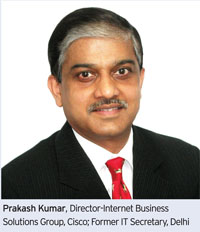 What has changed in the last six years in e-Governance in India?
Experimentation by large number of government departments was streamlined with introduction of National eGovernance Plan (NeGP) that gave right direction and focus in terms of common ICT infrastructure (SWAN/SDC/CSC) and detailed guidelines on eGov application. This has resulted in creation of basic ICT infrastructure, the information-highway on which many applications have started flowing to the people. There have been some delays and failures, but that is expected in a plan of such large magnitude. Railway reservation system, MCA 21, Stock exchange, Income tax and Customs are some of the success stories under central government. While automation has led to improvement in quality of services, there is enough scope for further improvement by making changes in way the citizens are serviced.
Where do you see e-Governance moving in the coming six to ten years?
Extensive use of ICT will lead to shift of power from the ‘Center’ to the ‘Edge’ i.e. people, making democracy stronger. Technology will enable citizens to participate better in decision making process and in prioritization of schemes and programs. Rapid advancement of technology will also ensure integration of services today delivered by different agencies, providing one view of the government to its people, the real ‘single window’. The SLA driven delivery will become the norm in next 5 to 6 years.
What all factors have proven to be the major bottlenecks?
Lack of skilled IT personnel with departments and frequent change of officials responsible for implementing the projects have been major bottlenecks. Complex and long procurement process has been another bottleneck, which needs to be streamlined and simplified urgently.
What are your recommendations on catalysing the execution and adoption of e-Governance and mitigating the digital divide in the country?
State IT departments as well as line departments have been finding it hard to create posts and if created, to attract and retain right talent in a highly competitive market. SeMTs and PeMTs are temporary measures and can be taken as a good starting point but departments needs such people on permanent basis to execute and oversee large IT projects.
The other recommendation would be to make a shift from procurement of compute/storage and application development to procurement of application as a service. Experience has shown that people will adopt a service if it is convenient, easily accessible and the people providing that service are seen as those who are ready to an extra mile to make the service seeker feel comfortable. Making services available through mobile phones or call centers with simplified application process will go a long way in quick adoption of eGov by people. Such measures will also reduce the digital divide because of very high penetration of phones in our country.