


The International Educational and Networking Forum for eHealth, Telemedicine and Health ICT

The Luxexpo Exhibition and Congress Centre in Luxembourg was host again to the international Med-e-Tel meeting held between the 16th and 18th of April 2008. In its 6th edition this year, and with a proven track record of highly efficient and effective networking, Med-e-Tel attracted once again a qualified audience of 500 Telemedicine and eHealth industry representatives, association executives, government officials, healthcare providers, payers/insurers and researchers from 54 countries around the globe.
Telemedicine and eHealth are all about making healthcare delivery more efficient and effective and to cope with some of the challenges that lie ahead, such as an ageing population, the rise in chronic conditions, the shortage of healthcare professionals, and the healthcare budgets. And development and implementation of telemedicine and ehealth tools require good coordination and mutual understanding between all parties involved (patients/citizens, care providers, government, health insurers, industry, research), so that the tools can be implemented and used in the most optimal way.

Med-e-Tel ’08 attendees agreed almost unanimously that the conference serves a great networking purpose and that it acts as a catalyst for formtion of partnerships between the different stakeholders, providing opportunities to share experiences, demonstrate technologies, and convey user needs among people with many different backgrounds and from many different places.

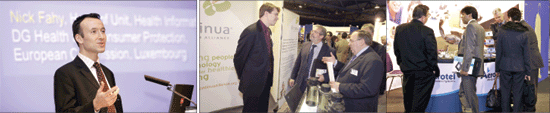
This year, participants were welcomed in an official opening ceremony by Mars Di Bartolomeo, Luxembourg Minister of Health, Prof. Dr. Michael Nerlich, President of the International Society for Telemedicine & eHealth, Pierre Gramegna, Director General of the Luxembourg Chamber of Commerce, Nick Fahy, Head of Unit, Health Information Unit, DG Health and Consumer Protection, European Commission and Prof. Giuseppe Tritto, President of the World Academy for Biomedical Technologies.

Following the opening ceremony and a tour of the exhibition, a keynote session, chaired by Frank Lievens, Secretary of the International Society for Telemedicine & eHealth, featured eight opinion leaders who shared their views and experiences on a number of current issues and initiatives, several of which were discussed further in more detail throughout various sessions of the three – day conference program.

Key Learnings
Dr. Yunkap Kwankam, eHealth Coordinator at the World Health Organisation, also present at one of the sessions, is a strong advocate of improving productivity through technology in the traditionally inefficient healthcare sector. He observed that one of the areas where technology can contribute a lot is training and education to scale up the workforce through eLearning programs. Kwankam, in his presentation also provided examples of improvement in clinical operations and increase of healthcare HR capacity through the use of electronic medical records. Health information networks are currently being put into place to collect health data and statistics for analysis, dissemination and use to support decision making in national and regional healthcare strategies, showing once again that eHealth is an essential component of any health system reform or development plans and strategies as far as WHO is concerned.
Nick Fahy of the Health and Consumer Protection Directorate-General (DG SANCO) of the European Commission shed light on the Commission’s “eHealth scenario for 2020”, a vision of what they would like to see operational in health ICT, from a public health and medical content point of view, in the EU context. The scenario is to provide helpful input for DG SANCO’s regulatory framework, financial envelopes and workplan, highlighting existing gaps and providing a clearer picture for coordination with the member states.
David Whitlinger, President of the Continua Health Alliance, provided an update on Continua’s progress in recent months in the development of guidelines for device makers, that should help consumers and healthcare providers to share information more easily through common communication channels such as cell phones, PCs, TV set-top boxes, telephones, and other devices.
Continua also held its Spring Summit in Luxembourg in the margin of the Med-e-Tel conference and conducted a so-called plugfest for its members, to test interoperability of devices and systems, and announced the release of Device Connectivity Standards and Healthcare Records Standards, which will lead to Continua certified products and software by the end of this year.
Michael Palmer, Project Officer at the ICT for Health Unit within the Information Society Directorate-General (DG INFSO) of the European Commission gave more background information on their recently released report on lead market opportunities for eHealth that proposes actions aiming at accelerating the development of the European eHealth market, increasing economic benefits and simultaneously develop the quality of health products and services. Palmer also highlighted details of the consultation that is being planned for this year in preparation for the Commission’s communication on telemedicine for chronic disease management.
Dr. Bill Crounse, Senior Director of Worldwide Health at Microsoft shared his perspectives on the growing opportunities for a new kind of medical practice based on personalised telehealth. “No longer in the sole domain of academic medical centres or large group practices, telemedicine has become a commodity technology with the promise to vastly improve the delivery of health information and medical services around the globe while reducing traditional doctor visits, saving money, and greatly increasing patient satisfaction,” he said. The presentation showed how innovative clinicians are incorporating Web 2.0 technologies into the practice of medicine and how organisations can benefit by staying ahead of the curve. Dr. Crounse also shared a “future vision” for healthcare that is more global, consumer-centric, based on cost and quality transparency, and personalised.
Dr. Joseph Kvedar, Director of the Center for Connected Health at Partners HealthCare, and Associate Professor of Dermatology at Harvard Medical School talked about how telehealth in the developing world can effectively address a range of health issues, including those affecting people with chronic diseases. The use of widespread, low-cost technology, such as cell-phones, creates opportunities for improved patient education and adherence to care plans, and better access to care providers. He also discussed the vision of “connected health”, which provides opportunities for more innovative programs to address chronic disease management.
Prof. Dr. Harald Korb, Medical Director at German-based telemedicine provider Vitaphone, in his presentation at the Med-e-Tel 2008 opening session, drew from experience with thousands of cardiovascular and diabetic patients, to show that a number of favourable effects can be guaranteed when modern telemedical devices with appropriate treatment pathways according to national and international guidelines are used in integrated care models.
And Dr. Loretta Schlachta-Fairchild, President & CEO of iTeleHealth (USA), sharing thoughts and visions for the creation of an International Telenursing Working Group within the frame of the International Society for Telemedicine & eHealth, with the goal of aligning with the International Council of Nurses (ICN), a federation of national nurses’ associations, representing nurses in more than 128 countries. “Given the worldwide nursing shortage and the global shift in demographics to ageing and chronic illness, it is paramount that nurses embrace technology as a resource multiplier”, said Schlachta-Fairchild. The envisioned working group will provide information and strategies to those interested in advancing their practice in this arena.
Med-e-Tel continued with an extensive conference program which featured an additional 150 presentations and workshops on a wide variety of Telemedicine and eHealth topics.
Through the variety of conference sessions, the exhibition and an extensive media corner (featuring some 35 journals, books and magazines), participants were provided with hands-on experience and an opportunity to discover and evaluate new systems and technologies and to hear about the latest eHealth and Telemedicine news, trends and developments, from companies and organisations around the world such as Aerotel Medical Systems, Agfa, Aipermon, Alcatel-Lucent, Center for Connected Health, Continua Health Alliance, eHIT, European Commission, GFI, Goodit, Honeywell HomMed, Intel, InterComponentWare, International Society for Telemedicine & ehealth (and about 20 of its member organisations), Management Cockpit, Microsoft, Philips, RS TechMedic, SAS, Vitalog, Vitalsys, Vitaphone Telemedicine, World Health Organization, YUSE, and many others.
|
Programe Highlights |
|