



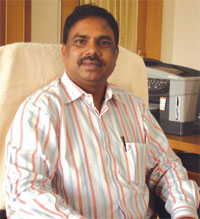
 T Krishna Prasad
Inspector-General of Police (Police Computer Services),
Andhra Pradesh Police
“Because of information derived from applications like third eye, many parts of the investigation are consistent and transparent. Resultantly, the Investigation Officers are able to file the charge sheet within the stipulated time as mentioned in Criminal Procedure Code (CrPC). Most importantly, the courts are now appreciating this move and thereby the rate of conviction has gone up”.

What is your perception about ICT implementation in police department?
Before an individual goes to police station to request a First Information report (FIR) or any grievance, primarily he/she hesitates and thinks at least twice before doing so. It is because of lack of two major factors in police stations, one consistency and another transparency. I will explain how. In a couple of similar theft or murder cases, lets say I am the Investigating Officer. Now according to the Standard Operating Procedure (SOP), the investigation in both of the cases should be identical. However, many a times one case becomes more important and another less important, though ideally, I should follow the same process for each of the cases. This is the lack in consistency in handling of several cases. Moreover, there is a lack of consistency among the police stations, as well.

The second factor is transparency. As an applicant, neither you know what is the process being followed in the investigation, nor you have any idea about the new developments in the case. This is the dearth of transparency. This is what we are trying to target. It is a huge challenge.

What are challenges on the way to ICT enabled policing?
On one side we have cultural and attitudinal issues. If you go to the lower level of hierarchy, the cops think hiding information is their right. . On the other hand, the police department is among the government departments that lack in terms of integrating themselves with the latest technology and simplification of processes. Technology was some thing, which was not being identified as a helping tool, except wireless communication systems. Therefore the staff is not typically tech savvy in police departments. They still depend on the outdated methodologies, on manual systems.

Percentage of the cases, investigated on the scientific evidence is quite low. Again, it’s a legacy. Police as an agency, particularly at the investigation level, has been overtly dependent on interrogations, and has more subjectivity, instead of objectivity. So finding out the truth, using the scientific methodology is the crux. And to move such an organisation, with employee strength of 1 lakh and 20 thousand, and which is not so tech savvy, is a mammoth task. So question is how to make it move towards this direction. This is a huge challenge.
How successful is the computer wing in putting the department on ICT mode, initiating the computerisation in 2002 with 400 desktops across AP?
It’s true we started with just 400 systems. From there, we have come to a situation today, where all of the 1643 police stations are having at least one computer, all of the 460 Circle Offices andabout 450 sub-divisional offices now have at least one PC. All districts Superintendent of Police, all of the senior officers, every body in the line, are having 1 PC today. Today we are having 5000-6000 constables who are trained in computers, who are given in-service computers training. About 5 constables in every police station are computer literate.
Now comes the application part. We have gone through a very strong and long process of evolution of software application. Learning in quite hard way over a long period of time, we have developed application called eCOPS or e-Computerised Operations for Police Services. This is an application that is fully tested and stabilised. It is fully functional today.
Can you elaborate on the enterprise version of eCOPS?
It is an initiative towards the standardisation of processes in the police department. eCOPS is a central mother application, which helps an SHO or the investigation officer in issuing an FIR and in the investigation. While developing this application, we developed detailed and long process flow chart, on how things go on in any typical police case. Interestingly, it involves a few hundred of steps until you file a charge sheet. After completion of this comprehensive and systematic flow chart, we moved to coding, and writing the language.
But policing is not just confined to the above-mentioned things, there are several other things done by the department like- grievance monitoring, inventory management, patrolling, surveillance, beats, traffic management. So you have eCOPS as the mother application surrounded by 47 satellite applications. Sitting in a police station, if I want to do multiple things together, I could not do that earlier, but with this enterprise application a cop can go to the website with his/her username and password, and he has options to work on multiple applications simultaneously. Also, the enterprise module requires the user to enter the data only once in some application and it is automatically copied and pasted in other required sections.
How effective are the applications like third eye and criminal intelligence system?
Third eye application: Third Eye is a very-very powerful tool in the hands of our forces. It’s a criminal intelligence software, which is actually a database of the people having passport, driving license, motor vehicle, voter ID, ration cards, cell phone, etc. So, in any given case, if a number related with these certifications comes across way of investigation, the cops can easily fetch it’s details. Earlier it used to take 40 days to get this information. Now with this application, a cop can have the same info in seconds.
Criminal Intelligence System (CIS): As Third Eye, Criminal Intelligence System is a data-mining tool, which helps the investigation officer (IO) to nab the criminals. It is a huge data bank on criminals and criminal gangs. It has a data of one lakh apprehended criminals and gang profiles. Using this application, a cop can identify a criminal through the modus operandi, through his first name, or alias name. Now, many of the parts of the investigation are consistent (because of information derived from third eye, CIS) and transparent. Resultantly, the IOs are able to file the charge sheet within the stipulated time as mentioned in Criminal Procedure Code (CrPC). Most importantly, the courts are now appreciating this move and thereby the rate of conviction has gone up.
Please throw some light on the CCTNS and recently mooted passport project.
Interestingly, there is a similar project planned at the national level by the MHA, Government of India –– Crime and Criminal Tracking Network System (CCTNS), which will be implemented all across the country. It is more or less the same what we did at the state level, in coordination with other state departments. It’s not that we have generated all of the data on our own. As in third eye, the concerned departments gave access to their data to our department, in the same manner in CCTNS we have to share the data at the pan India level. In a meeting held with Regional Passport Offi cer, we discussed on how do we ensure that citizens applying for a passport can get the status of the verifi cations online. The applicant submits his application to the regional passport offi ce, then the data comes to my offi ce from where it will be sent to the respective districts. Respective districts will do the verifi cation and will send back the reports to my offi ce. Now from here, a copy will be sent to passport offi ce so that they can process and provide the passport and another copy to the applicant. Meanwhile, if any citizen logs on to my site and asks for status, the system will tell him/her that the verifi cation is over and it has been sent to passport offi ce. Eventually this sharing of information through the partnership leads to better citizen service delivery mechanism.
Please tell us about the projects in the pipeline?
We have a proposal ready for a very signifi cant project in surveillance in particular and public safety and security in general, called Command and Control Centre. As you know, there are hundreds and thousands of security cameras (CCTV) deployed in most of the public and private vital installations and as well as in many of public places like airport, railway station, bus stands etc. If we integrate all of these cameras to a central server, we can make a master video wall. Now all these particular cameras windows will be watched by a group of people on selective basis.
In case if something fi shy pops up on a camera, the monitoring team can call the concerned the security department and in a moment of time they can very well see the exact situation. Now the beauty lies in integrating this camera to the system positioned in the offi ces of authorities sitting in Delhi or else where, with just passing on of the particular camera code. Through this way, the authorities will be able to see what exactly is going on and they can take the speedy decisions.
We have prepared another proposal for the use of biometrics in user authentication and monitoring at pan-India level and we are approaching the Government of India for it. Through a biometrics system, the palm of a person gets completely scanned, with the capturing of fi nger and thumb prints. With the availability of this system, the biometric identifi cation of all the arrested criminals can be easily done and the data can be stored in a central server.