
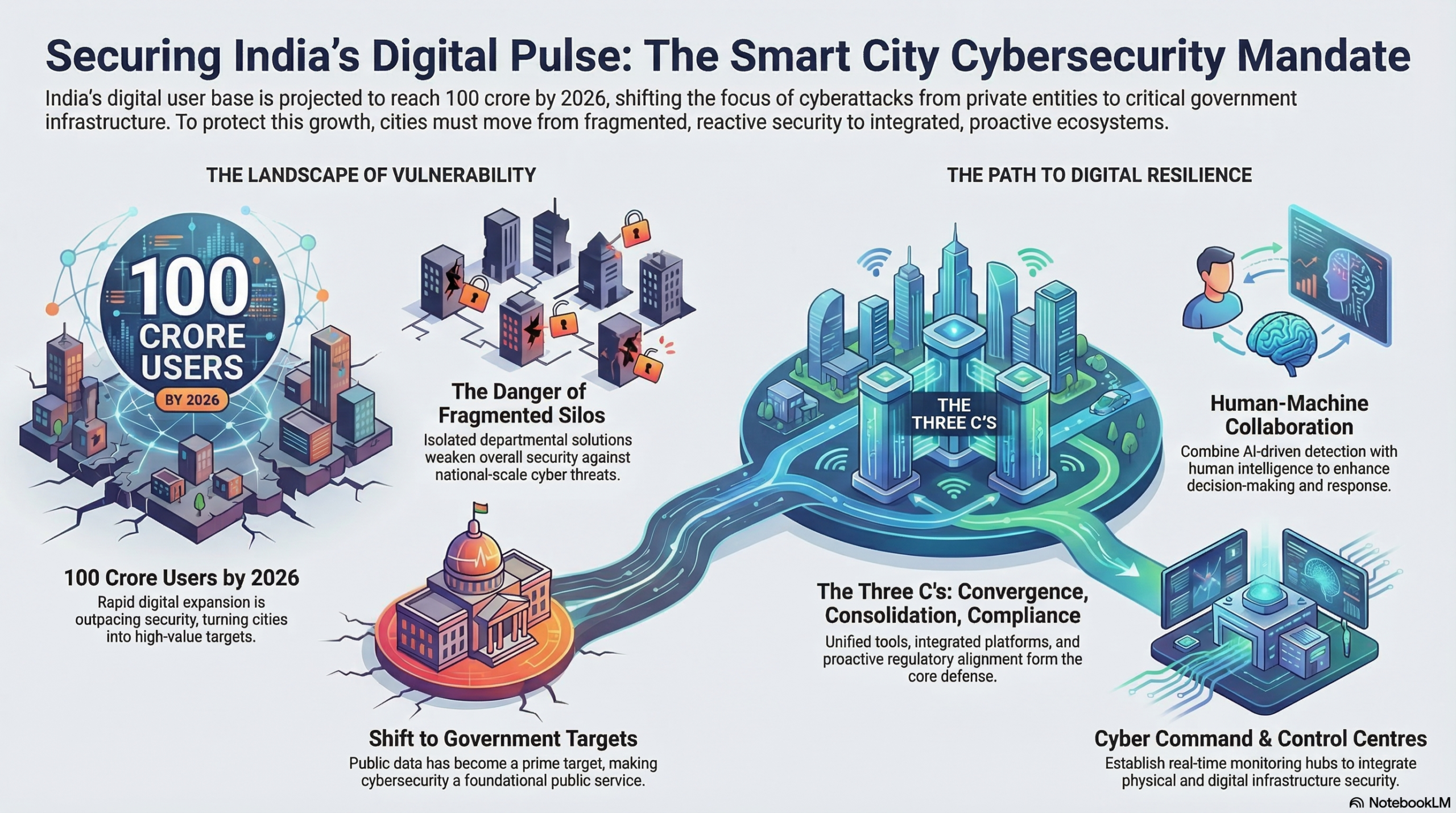
India is witnessing an unprecedented surge in digital growth. Over the past decade, internet users have increased from around 24 crore in 2014 to nearly 100 crore by 2026. This scale of expansion is rarely seen globally, with rural India contributing significantly, even outpacing urban regions in driving this growth. While this digital transformation is enabling cities to become faster, smarter and more efficient, it is also introducing new risks that cannot be ignored.

As digital technologies, artificial intelligence and data-driven systems continue to expand, the vulnerability of cities to cyber threats is also increasing. Earlier, cyberattacks were largely focused on private organisations, but today, government institutions have become prime targets. This shift highlights the growing value of public data and the critical importance of securing it.
Data today has become one of the most valuable assets. Past incidents in sectors such as aviation and healthcare have demonstrated how sensitive personal information can be exposed if not adequately protected. With more public services moving online, ensuring data security is no longer optional; it is essential.
One of the primary reasons behind rising cyber threats is the increasing complexity of digital systems. Multiple departments and organisations often operate in silos, deploying separate solutions that do not integrate with each other. This fragmented approach weakens overall security. Attackers are not targeting isolated entities; they are targeting systems at a national scale. This makes collaboration and integration across departments absolutely critical.

Another major challenge is the shortage of skilled professionals in cybersecurity. Despite widespread discussions around AI and advanced technologies, there is still a gap in skills and expertise. There is a need for more individuals and organisations to actively invest in learning, certification and capacity building in cybersecurity.

The way forward lies in human and machine collaboration. Technology alone cannot solve the problem, and neither can humans working in isolation. A combined approach, where machines enhance detection and response while humans apply intelligence and decision-making, is essential.

Three key principles need to be adopted: convergence, consolidation and compliance. Convergence means integrating multiple security tools into a unified system, similar to how smartphones have brought multiple functionalities into one device. Consolidation involves reducing fragmented solutions and adopting integrated platforms for more effective protection. Compliance requires a proactive approach, aligning with laws and regulations before incidents occur, rather than reacting afterwards.
Also Read: Designing Smarter Cities Through Knowledge, Research, and Innovation
A proactive mindset towards cybersecurity is critical. Security cannot be treated as a reactive measure. Just as preventive steps are taken in healthcare, similar thinking must be applied to cybersecurity. Many cyberattacks remain undetected for long periods, with data often compromised much earlier than when breaches are discovered.
In the context of smart cities, there is a need to integrate cyber, physical and operational systems to build secure infrastructure. Establishing command and control centres for cybersecurity can enable real-time monitoring and faster response to threats. At the same time, legacy systems must be modernised to keep pace with evolving risks.
As India moves towards a digitally empowered future, cybersecurity will become one of the most defining challenges. The next phase of urban development will not just be about infrastructure or growth, but about securing digital ecosystems. Ensuring safe, resilient and integrated systems will be essential to sustain the progress achieved through digitalisation.
Insights shared by: Lokesh Gautam, Systems Engineer, Fortinet, at the 6th Urban Innovation Summit 2026, held on 13th March 2026 at Taj Chandigarh