


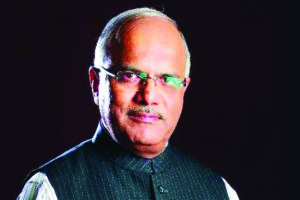
Member of Parliament
National Vice-President
Bharatiya Janata Party (BJP)
In our country, leadership has been confined to management science, whereas all other areas also require leadership. In order to offer that knowledge and help students understand and evolve, we have established the Indian Institute of Democratic Leadership, says Dr Vinay Sahasrabuddhe, Member of Parliament and National Vice-President of Bharatiya Janata Party (BJP), in conversation with Gautam Debroy of Elets News Network (ENN).

“In our routine life, in rural and urban environment, we have created a third environment – digital environment. In order to understand and evolve to digital protocols, not only knowledge but skills are also required.”
Share with us your vision on Indian education sector.

Education in India is in flux. Too many changes are happening and many more are required. The urgent requirement is that the educators who are running the educational institutions in India — principals, headmasters, vice-chancellors —need to take into account employability of the students.

 Most of the Indian universities produce graduates, post graduates and diploma or certificate holders who are not worthy of employment. This has been the observation of trade and industry sectors. They have their own examination and they are not happy with the results. Therefore, universities need to fine-tune their syllabus in such a way that the ‘employability quotient’ of a student could be enhanced.

The process of teaching has become very technical and has lost its vibrancy. Our glorious tradition of education puts emphasis on a very healthy and vibrant teacher-studentrelationship. Unfortunately, this is missing in the changing scenario. Therefore, greater coexistence staying together of the teacher and the student – is required. If that happens, we can achieve the objective of teaching and learning by illustrations and examples.

 The management in our world-class universities and institutions is in shambles. There are issues with which we are grappling for decades. For instance, admission procedures in our schools, colleges and universities are not very transparent and people are also not very confident that merit alone will be a decisive factor. So, it requires an urgent attention.
If we talk about examination procedure, it is also becoming extremely complicated. Universities have become examination conducting machines. Even evaluation of answer sheets is something which requires urgent attention. The course content is fairly Westernised, or is based more on theory and sometimes based on superficial understanding of the subject. The comprehensive mess in the content of our education requires special attention.
Indian Institute of Democratic Leadership has been recently setup. Tell us about this institute.
 The primary object is to promote the social, political and democratic leadership and thinking. The idea is to provide the largely technocrat young community with a chance to learn about political leadership, science and governance. In our country, leadership has been confined to management science, whereas all other areas also require leadership. In order to offer that knowledge and help students understand and evolve, we have established the Indian Institute of Democratic Leadership.
The government is taking a lot of initiative on Digital India. What do you think about it?
Digitisation is a process nobody can stop. It is impacting every citizen in multiple ways and multiple arenas. Therefore, a sound understanding of digital protocols is required. In our routine life, in rural and urban environment, we have created a third environment – digital environment. In order to understand and evolve to digital protocols, not only knowledge but skills are also required. These are the things we need to prepare our society for in the days to come.
“Greater coexistence – staying together of the teacher and the student – is required. ”
Late President APJ Kalam had a dream of making India a ‘superpower’ by 2020. How do you think this dream can be fructified?
Under an able leadership, India can certainly dream of becoming a ‘superpower’ by 2020. However, the superpower status should not remain confined to only possessing arms, ammunitions and technologies that are used in establishing military supremacy. When we say superpower, it also means that we should be capable of helping and mentoring all the disadvantaged, deprived and marginalised communities and countries world over to move towards progress. To take everybody towards development, ‘sabka saath sabka vikas’ is the only mantra and is applicable not only to India but to the whole world. In that context, I believe, under the leadership of Prime Minister Narendra Modi, India is certainly poised to become a Viswaguru or a superpower.?
eGov Magazine is coming with its 150th edition. What message would you like to convey to our readers?
As far as e-governance is concerned, magazines like eGov have a cut-role. With society moving towards an e-era: e-Public life, e-Governance, e-Administration- our social, professional, administration and governance lives are also changing. In a situation like this, magazines like eGov have a particular role in educating people because everything ‘e’ is not always good. In that context, magazines like eGov play a crucial role in developing a confidence on ‘e’ systems and working and fine-tuning wherever some reforms are required. All these issues need to be the agenda of the eGov magazine. I am sure whatever work you have already done, and contribution made in a particular sector so far, is certainly something which generates confidence and you will discharge your duties with conviction in the days to come.