


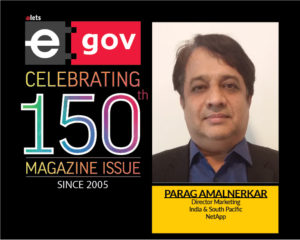
Director
Marketing, India & South Pacific
NetApp
The decibel levels surrounding India in the global conversation has increased in the recent years, partly as a result of over 109 new initiatives by the Government in the last two years, many of which are directed towards a vision of a new connected digital India.

In fact, according to the Digital Evolution Index 2016 by the Fletcher School, Tufts University, India now ranks amongst the “breakout countries” as far as digital adoption is concerned.
It’s a progress indeed. But I believe real success would be when we are able to say that our digital infrastructure truly enables the last man standing in the queue, seamlessly, transparently and in time.

So, despite the progress over the last few years, there is a chasm between where we are today where we should be. We simply cannot afford to rest on our laurels. There are two broad parts to this chasm — the physical and the technological. Technology that provides access to data and the ability to use it is just as essential as the physical infrastructure in today’s hyper-connected world.

The vision of a ‘smart India’ — intelligent, efficient, and able to provide rich experiences to its citizens – demands a clear data strategy – right from collection to analytics. Public services/schemes need access to data to improve safety and the quality of life, and technology providers need it to create the relevant, real-time interactions that define life in a modern India.

While Infrastructure improvements are ongoing and visible, there has been some progress on the technology side too.

About 80,000 of the 250,000 Gram panchayats are already covered with network infrastructure under the Digital India mission. Over 111 crore number of Indians have been linked already under the Aadhar Scheme, while Digilockers contain 175+ crore verified documents of over 75+ lakh registered users.
Armed with a strong backbone of physical and technological infrastructure, and a clear data strategy, India can leapfrog into the future, and jump generations, much like we have in the mobile revolution.
But the change is not easy.
Data collection is clearly under way, but as these massive projects move forward, they are not without their share of criticism.
My argument is that this criticism is a good thing, perhaps even necessary, in a democracy such as ours. Debates shape the conversation, and eventually define the correct path forward for a greater good.
Having said that, there is an opportunity, or perhaps it is even time, for India to reap the benefits of true data aware governance if only in byte sized experiences.
Considering healthcare, India has only 1.1 beds and 0.7 doctors per 1000 population. The Indian healthcare sector needs an estimated investment of $245 billion by the year 2034 to improve healthcare delivery through traditional methods.
This makes healthcare one of the most complex challenges of our time.
Is it possible to use existing technology investments and initiatives (mobile phones and high-speed data networks, Aadhaar and digital health records) to provide a pilot solution?
A solution that will provide better access to quality healthcare to those in need despite the physical infrastructure hurdles. Such a pilot could help bring India’s digital vision to life, and demonstrate in tangible terms the role data and technology can play in altering healthcare delivery and transforming public health.
A positive experience will likely help shape the nature of the debate, and carve a smoother way forward, if not help troubleshoot for the future.
I have a dream.
Our soon to be ‘smart’ cities will have technology as their core to deliver civic services efficiently and cost effectively. Technology will enable the gradual integration of government departments, planning processes and an intelligent and interconnected network of infrastructure services. Data will be the driving force – for intelligent traffic management system (ITMS), smart metering, water or waste management and smart sanitation.
If the last decade was about technology adoption, the next one will be about transformation. I foresee an India where every citizen is mapped better than Google Maps does for our streets.
I envisage a data-led governance paradigm that starts at the citizen level, goes to the state level and comes together at the national level. With the right data insight, access and control, India can significantly reduce urban chaos and ensure a better quality of life.