


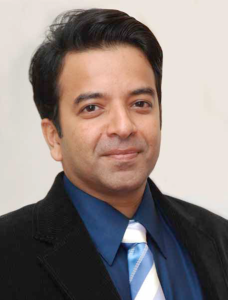
 Ambarish Deshpande
Managing Director – India Sales, Blue Coat Systems

“Blue Coat empowers enterprises to safely and securely choose the best applications, services,devices, data sources, and content the world has to offer, so they can create, communicate,collaborate, innovate, execute, compete and win in their markets,” Ambarish Deshpande
Today there are lots of concerns being expressed by government departments when it comes to security related issues. Tell us about the initiatives that Blue Coat is taking in the area of cyber security.
Government of India and the State governments have taken various e-Governance initiatives like the setting up of State Wide Area Networks,execution of UIDAI project and other Mission Mode Projects. There is always a security related concern when such a large infrastructure is created.It becomes essential for a country like India to set up systems to protect IT infrastructures from malicious cyber attacks. Blue Coat has developed expertise for safeguarding government data. We work with various governments around the world to set up safety infrastructures.We are the largest web security company in the world. On a daily basis we keep track of every malware that emerges. The concept of threat has been changed in the recent times. Earlier threats used to come through emails, but now they target social media platforms to breach security. The kind of security that we offer is not at all intrusive. We believe in creating a flawless security system that is most secure and is practically invisible.

How do you look at the safety infrastructure that we currently have in India? Is the nation’s data secure enough considering the magnitude of cyber threats that we face?
Earlier in India, building infrastructure was given more importance than the creation of adequate security mechanisms. It was almost as if security was being regarded as an afterthought. Today everyone is concerned about security, and I must say lot of good security related systems are being created by the government departments. It is being recognised that the security must be at the backend and it must be powerful enough to counter any attack on the system. However, I would say that there is ample scope for the security in government projects to be further enhanced. The government needs to focus on various consumer centric applications to ensure their safety. Even the defence establishment in India has realised the need of creating a separate force on cyber security. Mobile server safety is also an important area of concern. Today it is a fact that even in government departments people are using multiple mobile devices to do their work. They are downloading apps from consumer websites. At times, they are storing data on cloud. So we need to develop a model of security that takes into account the new devices and solutions that have become part and parcel of our lives.

Please provide us with a picture of the solutions that Blue Coat can provide to the government departments in India for enhancing their cyber security.
We are in a position to provide complete endto-end security solutions to the government. We are working with the Government of India and trying to pitch in the platform through which we can provide highly advanced security options. We can install firewall technology which acts like a blade for countering a phishing attack. Performance and scalability are two important factors in defining security. We also conduct SSL inspection in which we decrypt all the encrypted servers. We first analyse the content before passing it to the consumer. At Blue Coat we believe that security is not just about what you prevent. It’s also about what you make possible. Our approach to security is that it should be something that empowers the normal functioning of the department. It should make it more convenient for the departments to conduct their work.

What kind of infrastructures are you having in India?
We recently acquired three companies to enhance our expertise. One of the most important acquisitions is that of Solera Networks. The Solera Deep-See platform will add industry-leading security analytics and forensic capabilities to the Blue Coat product portfolio, delivering an end-to-end security solution that includes protection, remediation and governance and gives enterprises complete visibility into the content and context of advanced targeted attacks. Solera provides real-time visibility of advanced threats and zero-day attacks, it can also facilitate post-event ‘look back’ to easily identify the root cause and material impact of security breaches. We are currently working with many government departments in the country. We are also working with some of the leading private sector companies. We are also providing security solutions to nuclear power plants.

What kind of systems has Blue Coat developed to identify the root cause of threats?How do you tackle these threats?
You see, every threat that the hackers develop is based on a massive infrastructure. The hackers have to build servers and networks, which must become functional up to six months before the launch of attack. Once the attack is launched, it might go on for many days, before it will subside.The antivirus companies operate by writing the signature to identify the attack. However, we at Blue Coat also focus on the infrastructure and we try to block the malicious servers to prevent future attacks from happening through the same resource. This system of blocking the infrastructure, rather than just identifying the type of attack, is more effective in the long run.
“Our approach to security is that it should be something that empowers the normal functioning of the department”
Working with government is a challenge by itself. The decision making is slow and there are lot of approvals to be taken. So how do you manage the challenge of making government departments accept your solutions?
We work and interact with the top officials in the government. We create awareness among the government officials. We also take help of various top consultants like PWC and EY that are in constant touch with the government. We always try to interact with government officials on regular basis to give them the idea of latest cyber safety developments in the country. We work very closely with our partners and global governments. We share the experience on how the servers could be made more secure with the help of information technology. Government becomes a very key vertical in terms of security. India is at the right timeframe in the current scenario.
What kind of growth rates is Blue Coat seeing in India?
I feel that there are five countries in the world that are today focusing on security at a very large scale. These five countries include USA, Japan,India, Germany and Mexico. These countries will see huge investments in terms of security establishment. We are soon going to launch cloud based security solutions in India. We are geared up for the next level of cloud safety in India. We are bidding for projects that are of more than a million dollars. Our idea of development is to have better coordination. We are working to get feedbacks from Indian companies and government on the ways by which we can contribute towards enhancement of security.
What kind of policies should the government come up with to make it easier for Blue Coat to provide security?
Tell us about your expectations from the government. Indian government is already taking various steps for enabling better security systems. NIC is doing very good work in this area, and now there has been the appointment of a Cyber Security In-charge who reports directly to the Prime Minister. So lot of awareness is already there and we now see India as a very good business opportunity. We would like to make our contributions in enabling India bring its security infrastructure at par with what we have in the developed countries.