




The “Jansankhya Sthirata Kosh” (JSK) (National Population Stabilisation Fund) has been registered as an autonomous Society established under the Societies Registration Act of 1860. JSK has to promote and undertake activities aimed at achieving population stabilisation at a level consistent with the needs of sustainable economic growth, social development and environment protection, by 2045.

The Union Health Minister heads the General Body of the JSK and the Secretaries of the Ministries of Health and Family Welfare, Department of School Education & Literacy, Women and Child Development, Planning Commission, Rural Development, and the State Health Secretaries are members of the General Body of JSK. Besides this the General Body comprises demographers, representatives of Industry & Trade, NGOs, medical and para-medical associations, general citizens, institutions etc. JSK is expected to run as a civil society movement.
What is the main focus of JSK?
JSK was set up in 2003 to promote and support the Schemes, Projects, and initiatives that were to meet the unmet needs for Contraception and Reproductive and Child health. Rs. 100 crore were put in relief bonds in 2003, and the interest thereon has become available for us to work with.
Please share with us the structure and road map proposed for JSK?
Our memorandum says, civil society has to be involved, if we want to see change. And for the civil society to get involved, they have to see some actual work being done; which they might feel needs encouragement.
So first and foremost, JSK has to carve a niche area, which goes beyond what governments and NGOs are already doing.
Our governing board consists of government officers who are supposed to act as umpires and facilitators, and civil society partners which comprises FICCI, CII,renowned NGOs, demographers, preventive medicine experts, medical specialists, paramedics, nurses, so that we get a blend of professionals backed by government, so that no one sector becomes the over-riding interest group.
What prompted you into taking up this novel initiative of mapping of health facilities using GIS maps?
We are supposed to raise donations and resources for which we’ve been given 100% tax exemption. But you cannot raise resources till you yourself show that you are capable of using resources. So in the last one-year we had to plan initiatives and start implementing them because no one will take you seriously till you show something on the ground. And I must say that we have been supported very strongly by our governing board. They have allowed JSK to be as innovative as we wished.
What kind of response have you seen in the different parts of the country after your GIS mapping initiative?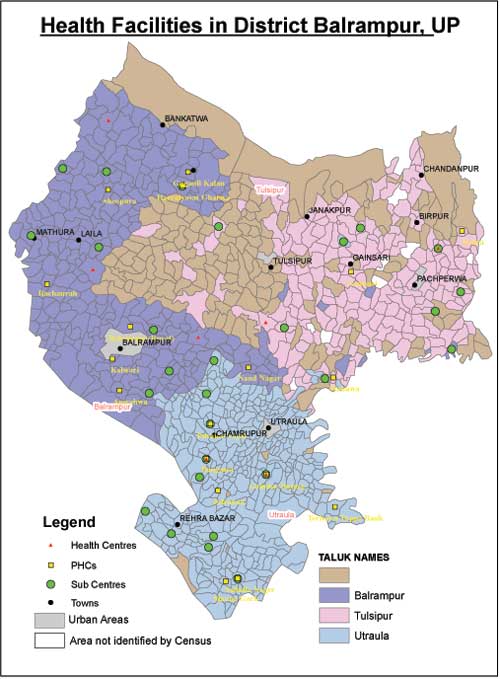
The purple areas on the GIS maps show areas where nobody has been working not even the NGOs. (On the other hand) I have visited talukas where people want to get a vasectomy done but don’t know where to go. If we give the service they come in large numbers. On one day in Gujarat in one district alone, they had done 1000 vasectomy operations. The motivators in these places were ANMs, anganwadi workers, self-help group people, peons and sweepers in the primary health centres. The health secretary was very encouraging which motivated them enormously.
The response we got in Gujarat was spectacular, MP was also very good, some parts of Rajasthan have also shown some initiative, but other northern states have not taken off…
We have done mapping to show where the total fertility rates are very high. The southern states, Himachal and Punjab have reached the fertility rate that the national population policy prescribes which is 2.1. The green states are soon going to achieve it. The red ones are going to take years to stabilize.
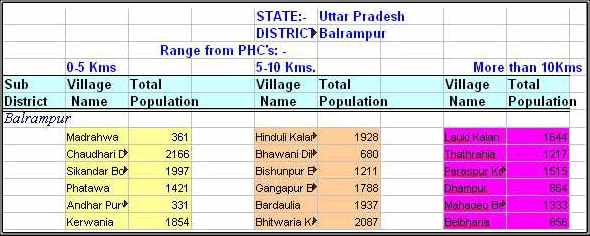
Excerpts from distance sheet
What role do you foresee for the private players in the healthcare sector?
There are plenty of new options for contraception, but we don’t have enough people trained to provide services. What we need is for private providers to be first trained to use certain skills and then to pay them to carry out these new methods. The government scheme is now very generous. It allows private providers to partner such projects. If JSK can partner with a private provider, empanelled with the state, instead of the per case cost he receives for single cases, JSK is willing to let him do a hundred cases and pay upfront. JSK is willing to do any handholding required, such as if they want to transport people from the purple areas, then JSK will support it as a pilot project to see if that really has an effect. JSK is willing to pilot one or two districts; if it works then the programme can be upscaled.
Having the GIS mapping for the whole country, it is possible to use the maps to pinpoint areas that deserve our focused attention.
Please share with us some future initiatives that you have planned for JSK.
We have planned to set up a call centre, which would give information on sexual health and everything to do with women’s and men’s health, from adolescence to infertility and menopause. All this information is available on our portal, and is in the process of being translated into Hindi. One also has the facility to even do a comparison of the different kinds of contraceptives/family planning methods available.
All this information is helpful if you are web-savvy which some may not be, so we want to set up a call centre. Such people can then pick up an ordinary phone and have a normal conversation with an actual person not some automated recording. There will obviously be with a disclaimer that it does not substitute for a doctor’s consultation.
We are now in the process of looking for a BPO to run it and for recruiting capable people to act as communicators.
We have also organised events in the past, where we have brought a large number of people from the purple (high fertility) areas where we setup sessions encouraging them to go back and become the ambassadors for these issues of gender discrimination, early marriage and population stabilisation.
We are also trying to encourage the district collectors; we are trying to get industry involved by using their hospitals (through FICCI). We’re also trying to see if we can work directly with the panchayats.
We are also setting up a Virtual Resource Centre, which would have audio visual material, film clips, images, posters which are on a meta- database so that anything (audio-visual) that comes gets uploaded; films on female foeticide, and related subjects.
What kind of help and infrastructure did you have on the technical front for the GIS initiative?
National Informatics Centre (NIC) has been very helpful. On the technical front, they gave us the server free of cost; in fact this whole thing was created by NIC. They had the GIS maps and the census data, and on my asking they said that one could superimpose the same data on the maps but they just did not have the time to do that. So I found them someone they agreed to train, but it was all done under their supervision and of JSK.
And we had the ranking of the districts done side by side, with bar charts by a young demographer straight out of International Institute of Population Studies.
For more information on National Population Stabilisation Fund log on to www.jsk.gov.in
