
Interview
Andhra Pradesh Redefining Urban Growth through PPPs and Digital Governance
Andhra Pradesh Redefining Urban Growth through PPPs and Digital Governance
![]() By
Elets News Network
By
Elets News Network


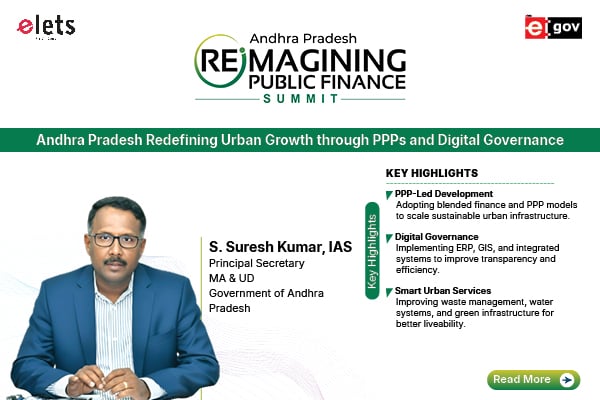
In an exclusive conversation, Shri. S. Suresh Kumar, IAS, Principal Secretary, Department of Municipal Administration & Urban Development (MA & UD), Government of Andhra Pradesh, shared with Muskan Jaiswal from Elets News Network (ENN) how Andhra Pradesh is redefining urban governance by blending fiscal innovation, technology-driven transparency, and citizen-centric reforms to shape resilient, self-sustaining cities of the future. Edited excerpts
How is the MA & UD Department integrating new financing models and public-private partnerships to drive sustainable, revenue-generating urban infrastructure aligned with Andhra Pradesh’s growth vision?
The MA&UD Department has strengthened the fiscal foundations of all 123 ULBs to enable future access to Public-Private Partnerships (PPPs) and external financing.
- Each ULB operates under a unified chart of accounts integrated with the Comprehensive Financial Management System (CFMS) to ensure accurate, auditable expenditure and receipt tracking.
- The Department is transitioning from a grant-based to a blended financing model, combining own-source revenues, 15th Finance Commission grants, and structured PPP mechanisms aligned with the PPP Policy. (Refer to page 6 of the draft PPP policy 2025)
- The PPP Policy establishes clear frameworks for Design–Build–Operate–Transfer (DBOT) and Hybrid Annuity Models for urban services, including solid waste management and sanitation. It also standardises risk allocation and performance-based payments (Refer to pages 7-8 of draft PPP policy 2025).
AP have put in place NMAM-compliant accounting, verified asset registers, and a standard PPP framework to convert urban infrastructure projects into revenue-generating, investible opportunities across all 123 ULBs.
What innovative tools and strategies are being deployed to enhance the financial health of Urban Local Bodies (ULBs), including land monetisation and improved municipal service delivery mechanisms?
- The Capital Value System (CVS) for property tax is being implemented, which aligns taxation with current market rates and improves transparency.
- Auto-Mutation of the title of the property owner is being implemented in 17 Municipal Corporations, which enables speed and transparent service delivery, and it will be upscaled to the remaining ULBs.
- The Enterprise Resource Planning (ERP) platform integrates modules for Property Tax, Water Charges, Trade Licenses, and Non-Tax Revenue, automating demand generation and reconciliation.
- Asset Management Module (AMM) has recorded 67,178 municipal assets with a cumulative value of ₹7,357 crore, enabling valuation-based decision-making for asset monetisation.
- The Geographic Information System (GIS) and Naksha Re-survey are being rolled out to update the property database.
- Potential land parcels are being mapped for lease, joint development, and value capture mechanisms.
AP is expanding municipal own revenues through Capital Value property tax reforms, asset valuation, GIS re-survey and auto-mutation. These tools build stronger municipal revenues and open the path for potential asset monetisation.
How is the department ensuring that investments in core areas like waste management, green infrastructure, and smart water solutions directly contribute to both fiscal strength and urban quality of life?
- Integrated Solid Waste Management (ISWM) projects under SBM – Urban adopt cluster-based operations, enabling shared treatment facilities and reducing the per-ton cost of processing.
- Ensuring Functional Household Tap (FHTPs)/ Drink From Tap to all the households in the ULBs. The ERP integrates water billing with property taxes.
- Smart Water Management interventions under AMRUT 2.0 have been aligned with real-time consumption tracking and reuse monitoring to reduce non-revenue water losses.
- Replacing the conventional street lights with energy-efficient LED lights (approx. 7 lakh lights) across all ULBs has been achieved, ensuring considerable energy conservation (approx. 30-40% energy savings). Now, contemplating going for Solar Lights to the extent possible.
- Solar Power Projects (both rooftop and land-based) are under consideration for improving the green power coverage in ULBs.
- Through Andhra Pradesh Greening and Beautification Corporation (APGBC), green coverage in urban areas is being improved through rejuvenating water bodies with required plant species and also taking up plantation in avenues and also municipal open spaces and parks.
AP is ensuring that investments in waste and water not only enhance liveability but also strengthen fiscal sustainability.
Digitisation for transparency, accountability, and citizen engagement. Can you describe how digitisation and technology adoption are improving transparency, accountability, and citizen engagement in urban planning and budget utilisation?
- The Finance Module automates accounting workflows, bank reconciliation, and the generation of financial statements for all ULBs, ensuring transparency.
- A unified MA&UD Dashboard tracks district and ULB-level performance, ranking cities under ‘Star Rating’ and recognising high performers monthly.
- Citizen-centric platforms such as Puramithra, Mana Mitra (WhatsApp), facilitate direct citizen engagement.
- Auto-Mutation of the title of the property owner is active in 17 Corporations
- GIS integration streamlines the property database, reduces disputes and improves accountability.
Digitisation has transformed the person-dependent services into an open, data-driven system. Citizens can now see, report, and track the application status, etc. in ULBs.
What key lessons have emerged from recent urban development projects regarding financial resilience and risk management, and how are these shaping future urban finance policy in Andhra Pradesh?
- System integrity first – Reliable accounts, automated closures, and CFMS integration are essential before borrowing or PPP transactions.
- Verified assets unlock options – The complete asset inventory valued at ₹7,357 crore provides a base for leases, joint ventures, and valuation-backed financing.
- GIS and Auto-Mutation expand revenue – Digital mapping and automatic updates keep property databases current, improving tax coverage.
- Integration of service and finance data improves tariffs – Linking billing of all taxes and non-taxes through ERP supports for finance improvement.
- Public dashboards enhance investor confidence – Transparent municipal data and digital governance improve confidence amongst the citizens as well as the investors.
Policy direction
- Complete valuation and re-audit of ULB assets.
- Universal adoption of Auto-Mutation for all ULBs.

Be a part of Elets Collaborative Initiatives. Join Us for Upcoming Events and explore business opportunities. Like us on Facebook , connect with us on LinkedIn and follow us on Twitter, Instagram.
"Exciting news! Elets technomedia is now on WhatsApp Channels Subscribe today by clicking the link and stay updated with the latest insights!" Click here!