
In India, pilgrimage centres are not merely places of worship; they are living institutions that carry centuries of faith, tradition, and collective memory. Managing such sacred spaces in an era of rising footfall, complex protocols, and citizen expectations demands governance models that respect tradition while embracing technology. The Bhakti Path initiative at Shri Omkareshwar Jyotirling stands as a compelling example of how digital transformation can enhance spiritual experience without diluting sanctity.

Conceived and implemented by the district administration of Khandwa, Bhakti Path represents a comprehensive re-engineering of temple management through e-governance, aimed at improving devotee convenience, safety, transparency, and administrative efficiency. The initiative transforms a previously manual, fragmented system into a future-ready, integrated, and citizen-centric digital ecosystem.
Objective of the Project
The core objective of Bhakti Path is to modernise temple administration by transitioning from manual and opaque processes to a digital, efficient, and transparent system that enhances the overall devotional experience. The project focuses on re-engineering legacy workflows using technology-led solutions such as online time-slot-based darshan booking, secure QR-based wristband entry, and the E-Aradhana platform that enables devotees to perform Poojan remotely.

Additional components include an automated Protocol Management System, AI-based crowd monitoring dashboards, and the Samvad Setu communication network to improve coordination among departments and reduce delays. Supporting features such as digital signages, cashless payments, online stay and prasad booking, and 24×7 live darshan collectively contribute to a seamless, accessible, and devotee-focused temple ecosystem.

Beneficiaries of the Project

Bhakti Path benefits a wide range of stakeholders. Devotees are the primary beneficiaries, gaining easy access to services such as online darshan booking, digital payments, and real-time information. Elderly devotees, persons with disabilities, and those living far from Omkareshwar benefit significantly from the E-Aradhana system, which allows participation in sacred rituals from home.
Temple staff and officers benefit from improved tools for crowd management, record-keeping, and coordination. Local communities gain from cleaner, safer, and more organised temple operations, while global devotees are able to connect spiritually through live darshan and remote Poojan services.
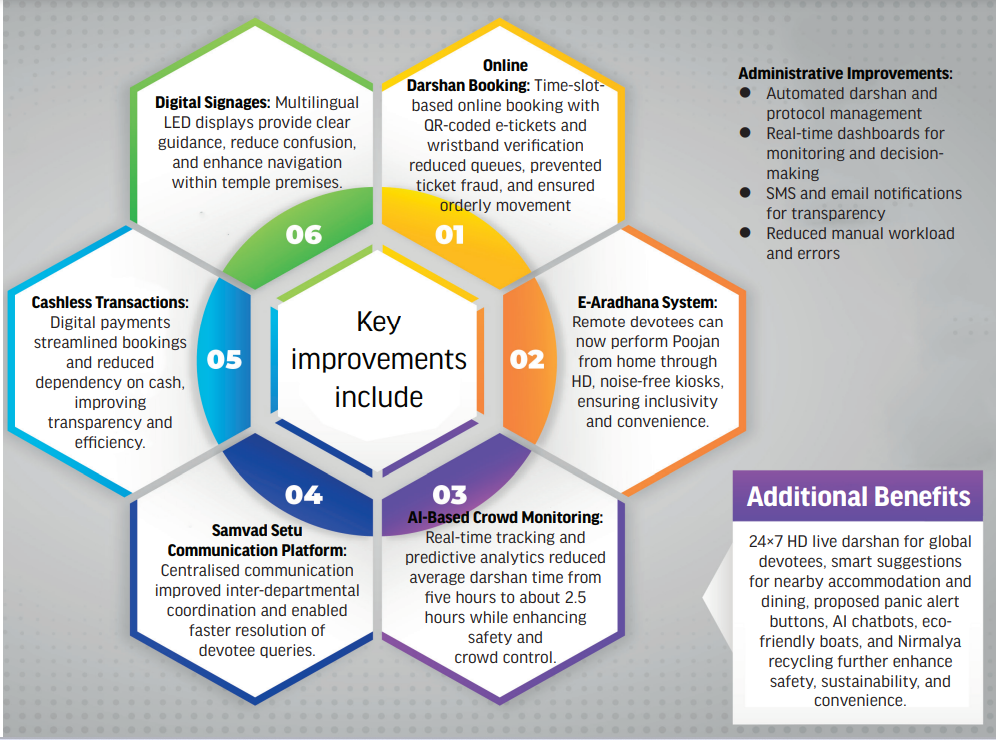
Details of the Project
The Bhakti Path transformation was implemented to modernise the management of Shri Omkareshwar Jyotirling, which previously relied on manual systems that struggled to manage increasing footfall and lacked transparency. The district administration undertook a comprehensive process re-engineering exercise using e-governance tools to create a smooth, secure, and technology-enabled devotional experience.
One of the most significant reforms was the introduction of online, time-slot-based darshan booking, replacing manual coupon distribution. This ensured regulated entry, eliminated long queues, and prevented sudden crowd surges. Secure QR-coded e-tickets and wristband verification further strengthened access control and eliminated ticket duplication and fraud. The E-Aradhana system emerged as a transformative inclusion initiative, allowing remote devotees to perform Poojan through portable HD kiosks with noise-free communication. This was particularly beneficial for elderly devotees and those unable to travel. Protocol darshan for VIP visits was streamlined through an automated online system that assigns nodal officers and sends real-time SMS alerts, ensuring minimal disruption to regular devotees.
To improve communication, the Samvad Setu platform integrates automated SMS and WhatsApp support, significantly reducing confusion and response time. AI-based crowd dashboards provide real-time data on hourly footfall, queue speed, and predictive analytics, enabling proactive crowd management. As a result, average darshan time was reduced from nearly five hours to approximately two and a half hours.
Supporting systems such as digital signages, online booking for accommodation and meals, UPI-based cashless payments, and round-the-clock live darshan further enhanced accessibility. The initiative caters to lakhs of pilgrims from Madhya Pradesh and across India, while also serving global devotees through digital channels.
Impact in Terms of Time and Cost Saving
Bhakti Path has delivered substantial time and cost savings for both devotees and administrators. With online time-slot booking, devotees no longer spend hours waiting in queues. The reduction in darshan time from five hours to about two and a half hours has significantly reduced physical strain, travel fatigue, and crowd-related stress.
Remote devotees save considerable travel time and expenses through the E-Aradhana system, which allows them to perform Poojan without physical presence. The QR-based e-ticket and wristband system eliminates repeated counter visits and reduces losses due to mismanagement and ticket fraud.
AI-driven crowd monitoring enables better visit planning, helping devotees avoid peak congestion and reduce incidental costs related to food, lodging, and transport. Samvad Setu minimises the need for repeated visits or calls for information. Digital payments and advance guidance through LED signages further reduce transaction time and eliminate cash-handling inefficiencies. Overall, the initiative delivers faster services, fewer physical visits, and lower administrative and personal costs.
Uniqueness of The Initiative
Bhakti Path is unique as a district-level initiative that delivers end-to-end digital transformation of a major pilgrimage centre through integrated e-governance. The convergence of online darshan booking, QR-wristband security, AI-based crowd monitoring, and remote E-Aradhana is rare in temple management.
The initiative also integrates sustainability through eco-friendly boats and Nirmalya recycling, linking digital governance with environmental responsibility. By blending tradition with technology, Bhakti Path establishes a transparent, efficient, and devotee-centric governance model seldom seen at the district level.
Situation Before The Initiative And Specific Challenges Faced
Before the Bhakti Path initiative, temple management at Omkareshwar was largely manual, fragmented, and unable to cope with the steadily increasing footfall of devotees. The absence of structured digital systems resulted in inefficiencies, inconvenience, and lack of transparency for both citizens and administrators. (Check Table -1)
Overall, citizens faced long waits, confusion, lack of clarity, environmental discomfort, and low service transparency. For administrators, the absence of digital tools hindered coordination, monitoring, accountability, and efficient service delivery. These challenges necessitated a comprehensive, technology-driven transformation.
Situation After The Initiative
After the implementation of the Bhakti Path initiative, temple management at Omkareshwar underwent a complete digital transformation, resulting in improved efficiency, transparency, and devotee satisfaction.
Overall, the Bhakti Path initiative has transformed temple operations into a faster, safer, transparent, and citizen-centric system, significantly improving both devotee experience and administrative efficiency while making the temple ecosystem future-ready.
Conclusion
The Bhakti Path initiative at Omkareshwar demonstrates how modern, technology-enabled governance can coexist harmoniously with faith and tradition. The transformation is not merely operational but behavioural—reshaping the relationship between devotees and administration from a transactional interaction to one built on trust, fairness, and transparency.
Through data-driven governance, digital transparency, and process reform, the Omkareshwar model proves that devotion and good governance can go hand in hand. Bhakti Path offers a replicable blueprint for pilgrimage centres across the country, showing how thoughtful use of technology can elevate spiritual experience while ensuring efficiency, inclusivity, and accountability.
Views expressed by Rishav Gupta, IAS, District Magistrate, Khandwa, Madhya Pradesh