


When it comes to building India’s public digital infrastructure, the C entre for Development of Advanced Computing (C-DAC) has been one of the country’s most consistent and mission-driven institutions. Established in 1988 as an autonomous scientific society under the Ministry of Electronics & Information Technology (MeitY), C-DAC has built national capability across advanced computing, high-performance systems, artificial intelligence, multilingual technologies, cybersecurity, and large-scale digital platforms. Over the decades, this capability base has consistently strengthened governance systems, empowered industries, and enabled inclusive societal applications nationwide.

Artificial Intelligence (AI) at C-DAC is not a recent adoption; it has been a sustained R&D thread shaped by close partnership with the government, central, state, and local. The emphasis has been application-first and AI as a practical tool to improve governance outcomes and enable efficient, transparent, citizen-centric services through mission-mode products and platforms.
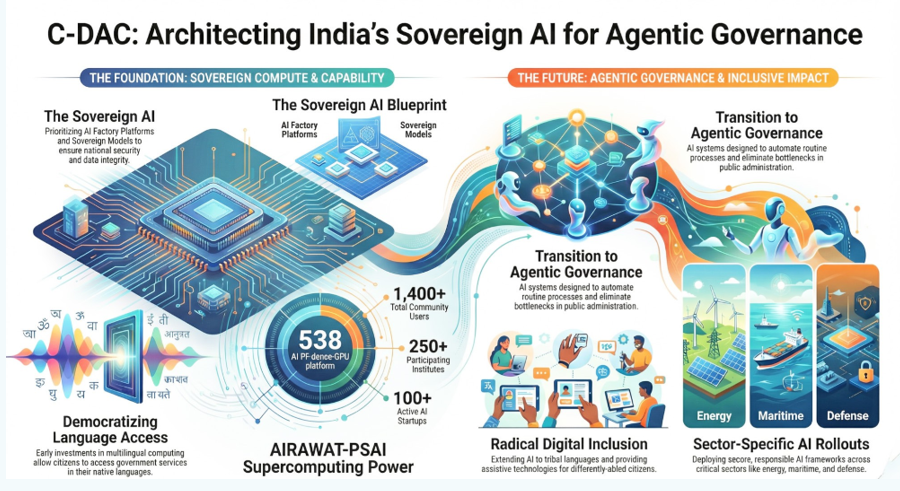
Language, arguably India’s most persistent barrier to digital inclusion, became one of C-DAC’s earliest proving grounds. Long before AI became mainstream globally, C-DAC invested in multilingual computing and machine translation so that citizens could access government services in their own languages. Its Indian language translation systems were among the earliest deployed in the country and continue to support multiple government organisations, democratising access to information and public services.


From capability to governance impact

Over time, C-DAC strengthened the ecosystem around AI in two complementary ways: capacity building through training programs, and the creation of indigenous compute infrastructure and AI platforms that support innovation and deployment. This matters because “AI in governance” is not only about algorithms; it is about ensuring that public institutions can adopt, operate, and sustain AI systems reliably at scale.

A flagship national example of the compute capability is AIRAWAT- PARAM Siddhi AI (AIRAWAT-PSAI)—a
Government of India initiative steered by MeitY and commissioned by C-DAC as a converged HPC-AI dense GPU infrastructure. AIRAWAT-PSAI is a 538 AI PF dense-GPU National AI supercomputing platform that enables large-scale, indigenous AI research and deployment for the country’s priority needs through the AIRAWAT portal (airawat.cdac.in). It connects Centres of Research Excellence in AI, Indian Centres for Transformational AI, academic and research labs, the scientific community, PSUs, industry, MSMEs, and start-ups. Today, 1400+ users (including 100+ start-ups) from 250+ institutes/organisations are part of the AIRAWAT-PSAI community.
As AI becomes central to the next phase of digital governance, C-DAC is developing and deploying solutions across a wide spectrum of functions. A particularly important step is the move toward Agentic AI, systems designed to automate routine processes, reduce manual bottlenecks, and improve responsiveness in public administration. By redesigning workflows, day-to-day governance will become faster, more reliable, and easier to audit.
C-DAC has captured the imagination of citizens and policymakers, and is working on the solutions as expected. The institution sees itself as committed to delivering on national visions such as IndiaAI goals toward 2030 and the broader Viksit Bharat 2047 ambition by anchoring adoption in capability, trust, and measurable outcomes.
Responsible and inclusive governance
The future vision is explicitly inclusive, advanced language AI extended beyond major Indian languages to tribal and low- resource languages, and AI-powered assistive technologies to empower differently-abled citizens with equitable access to digital services. The roadmap also recognises AI’s role in widening economic participation, for example, enabling the banking sector with AI resources to extend credit and financial services to those beyond the reach of formal credit systems.
At the platform and governance level, C-DAC is building a blueprint that prioritises pillars such as an AI Factory Platform, Sovereign Models, and Responsible AI. The goal is not just to “deploy more AI,” but to ensure quality, security, accessibility, and inclusivity are designed into every AI implementation, no matter how big or how small. This includes compute and system engineering for Sovereign AI and secure rollouts for critical sectors such as energy, maritime and defence.
Partnerships, people, and cultural knowledge
No national-scale AI journey is possible without the ecosystem moving together. C-DAC’s applied R&D approach is partnership-driven, working with academia and industry to build next- generation AI platforms, standards, ethics frameworks, and deployments, while preparing the workforce through skilling and reskilling.
Also Read | India’s AI Path: Building Intelligence That Works at Population Scale
One flagship initiative taken up by C-DAC is to build on our language- technology work and use AI (and other emerging tools) to preserve and bring Indic knowledge and cultural heritage into the digital age, so this civilisational knowledge becomes easier to access, use, and search, in collaboration with academia and industry. Internally, C-DAC is upgrading readiness by reskilling teams, integrating AI elements into regular programs post graduate certificate programs, and creating open frameworks to share compute and AI facilities across centres connected over the National Knowledge Network, so lessons and learnings compound across the organisation.
In essence, C-DAC’s mandate in the AI era is to make AI a force multiplier for governance and economic growth, ensuring benefits reach every citizen, and advancing the commitment to “AI for all” in a Viksit Bharat.
Views Expressed By: Shri E Magesh, Director General, C-DAC